Showing posts with label heterodontosauridae. Show all posts

Friday, October 15, 2021

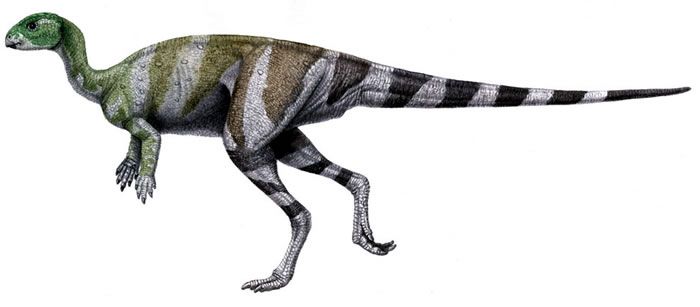
Fruitadens

Type Species
: Fruitadens haagarorum
Classification: Dinosauria - Ornithischia - Heterodontosauridae
Time Period: Late Jurassic 
Location: North America 
Diet: Omnivore

The heterodontosaur Fruitadens is the smallest known heterodontosaur. It’s known from partial skulls and skeletons from at least four individuals of differing biological ages; the presence of these skeletons in the same locale indicate that this heterodontosaur may have travelled in family packs. Young adults grew to around 26 to 30 inches in length and weighed between a pound and a half. Fruitadens had relatively short arms and long feet and shins. The lower jaws had an enlarged canine-like tooth which corresponded to a gap in the upper jaw. Fruitadens also had a small peg-like tooth in front of its canine-like tooth. It had replacement teeth present in the jaws, a unique find among other heterodontosaurs. Its hind limb bones were hollow like those of small theropod dinosaurs. 

Paleontologists believe Fruitadens was an omnivore, and it lived in an environment rich with food for the plucking. It likely prowled the many riverbeds and streams of the savannah-like Morrison Formation, feeding on plant material in addition to snails, clams, crayfish, and insects. Being on the smaller size, it would’ve been wary of running across crocodylomorphs. While large theropod dinosaurs such as Allosaurus, Ceratosaurus, and Torvosaurus lived in the same environment, Fruitadens would’ve likely evaded these predators by running into heavy thickets or hiding in the gallery forests spreading out from rivers and lakes. 

Friday, July 17, 2020

Tianyulong

Type Species: Tianyulong confuciusi
Classification: Dinosauria - Ornithischia - Heterodontosauridae
Time Period: Late Jurassic
Location: China
Diet: Herbivore   

Tianyulong was a Late Jurassic heterodontosaur that lived during the Oxfordian stage of China. Its remains were discovered in the Tiaojishan Formation of China. During prehistoric times, this mountainous landscape was overshadowed by brooding volcanoes that had a penchant for erupting; the area was cut by mountain streams and deep sapphire lakes choked by dense gymnosperm forests. The jungle-like forest consisted of ginkgoes and conifers, lycopsids and horsetails, cycads and ferns. Many creatures called this place home: small feathered dinosaurs, numerous pterosaurs, salamanders and insects and arachnids. There were early mammals – including the earliest gliding mammal Volaticotherium and an aquatic protomammals Castorocauda. Tianyulong skittered among the jungle-choked ravines and waterways of this prehistoric Chinese environment. It was descended from the earlier heterodontosaurs of the Early Jurassic, and though it had classic heterodontosaur characteristics – in particular its mixed collection of teeth and large tusks at the front of the mouth – it had evolved distinct differences. Its head was large, and its legs and tail were long, but its neck and forelimbs were unusually short. Tianyulong’s diverse array of teeth indicate that it was capable of eating meat, but it was likely herbivorous; nevertheless, the possibility of an omnivorous diet remains. 

Tianyulong had a row of long, filamentous integumentary structures on its back, tail, and neck. The similarity of these structures with those found on some theropods suggests their homology with feathers and raises the possibility that the earliest dinosaurs and their ancestors were covered with homologous dermal filamentous structures that can be considered primitive feathers (often called ‘proto-feathers’). The hollow filaments are parallel to each other and are singular with no evidence of branching. They also appear to be relatively rigid, making them more analogous to the integumentary structures found on the tail of Psittacosaurus than to the proto-feather structures found in avian and non-avian theropods. Among the theropods, the structures in Tianyulong are most similar to the singular unbranched proto-feathers of Sinosauropteryx and Beipiaosaurus. Because such structures had previously only been seen in derived theropods and ornithischians, their discovery in Tianyulong puts the existence of such structures further down the phylogenetic tree (as heterodontosaurs were rather ‘primitive’ ornithischians). The presence of these structures on Tianyulong is thus explained in one of two ways: either the common ancestor of both saurischians and ornithischians were covered by feather-like structures, and some branches of the dinosaurian lineage ‘lost’ them to become ‘secondarily featherless;’ or these structures evolved independently in saurischians and ornithischians, as well as in other archosaurs such as the pterosaurs. The precise ‘genesis’ of proto-feathers is hotly debated and there remains no consensus.

Sunday, June 14, 2020

Pegomastax

Type Species: Pegomastax africana
Classification: Dinosauria - Ornithischia - Heterodontosauridae
Time Period: Early Jurassic
Location: South Africa
Diet: Opportunistic Omnivore

Pegomastax lived in Early Jurassic South Africa between 200 to 190 million years ago. This creature was much smaller than other heterodontosaurs of the environment, such as Heterodontosaurus and Lesothosaurus. While the latter dinosaurs reached between four and six feet, Pegomastax measured just under two feet head-to-tail. The parrot-like Pegomastax had a robust lower jaw with a short beak and an enlarged canine-like tooth at the beginning of the lower jaw’s tooth row. This canine-like tooth may have been a defensive weapon, or it may have been used to dig for roots and shrubs. 

Pegomastax had thin, porcupine-like spikes that sprouted over its body. These could’ve been used as a defensive function, like porcupines, or to make the creature unappealing to predators. Or, perhaps, they were used to make it look bigger – it was a little squirt, after all, who weighed less than an average housecat – in order to intimidate rivals or predators. Another theory is that they were used for sexual display to attract mates. World-renowned paleontologist Paul Sereno described Pegomastax as a ‘nimble two-legged porcupine,’ adding, ‘I think the bristles would’ve made it look at least a little bigger than it was – perhaps they could poke out more strongly when excited… [Its] main defense would be the speed of escape. These were very fast long-legged critters. They could inflict a nipping bite if cornered, using the fangs much like a peccary or fanged deer.’

Lesothosaurus

Type Species: Lesothosaurus diagnosticus
Classification: Dinosauria - Ornithischia - Heterodontosauridae
Time Period: Early Jurassic
Location: South Africa
Diet: Opportunistic Omnivore

Lesothosaurus was an herbivorous or omnivorous heterodontosaur from South Africa. It lived in a semi-arid environment about 200-190 million years ago during the Early Jurassic. It could grow up to six feet in length. It had long, slender legs, small arms with four-fingered hands that weren’t great at grasping, and a slender tail. It was probably a fast runner. Its neck was short but flexible; its skull was short and flat; and it had large eye sockets. It had a short, pointed snout that ended in a horny beak. Behind the beak were leaf-shaped teeth lining the jaws, and near the front of the upper jaws it had twelve fang-like teeth. Lesothosaurus sliced up its food with the beak, but it wouldn’t have been able to chew very well. Studies of tooth wear show less abrasion on the teeth than are expected with an herbivore, indicating that Lesothosaurus was an opportunistic omnivore that fed on plants during the wet seasons and small animals during the dry seasons. It had a distinctive femoral head not seen in other dinosaurs, and it was likely gregarious, living in social groups. 


Saturday, June 13, 2020

Abrictosaurus

Type Species: Abrictosaurus consors
Classification: Dinosauria - Ornithischia - Heterodontosauridae
Time Period: Early Jurassic
Location: South Africa
Diet: Herbivore or Omnivore

Abrictosaurus was a heterodontosaur that lived in South Africa during the Hettangian and Sinemurian stages of the Early Jurassic 200-190 million years ago. It’s known from the fossil remains of two individuals. Its habitat consisted of sand dunes and seasonal floodplains in a semiarid environment with sporadic rainfall. It likely practiced niche partitioning in its herbivorous eating habits, sharing the ecosystem with other heterodontosaurs like Heterodontosaurus and Lycorhinus. Other organisms in the environment included land-dwelling crocodylomorphs, early mammals, the theropod Coelophysis, and the prosauropod Massospondylus

Abrictosaurus had large, canine-like tusks – called ‘caniniforms’ – in both its upper and lower jaws. It had no teeth in the front of its jaws; in its place was a hard beak likely used to crop vegetation. A handful of primitive heterodontosaur features indicate that it is the most basal member of Heterodontosauridae. For example, Abrictosaurus had widely separated cheek teeth with low crowns more similar to other ornithischians, whereas Heterodontosaurus and other heterodontosaurs had high-crowned cheek teeth that overlapped each other in the jaw to form a continuous chewing surface similar to the later Cretaceous hadrosaurs. Another example is in Abrictosaurus’ tusks, which were more primitive than those of more derived heterodontosaurs. It’s widely believed that Abrictosaurus was a gregarious creature; this is indicated by the fact that one of the two specimens recovered has much smaller tusks. This may be an example of sexual dimorphism; in many modern mammals, tusks of different sizes are used to differentiate gender with musk deer, walrus, Asian elephants, and many pigs. Thus it’s likely that the fossilized remains belong to both a male and a female Abrictosaurus


Heterodontosaurus


Type Species: Heterodontosaurus tucki
Classification: Dinosauria - Ornithischia - Heterodontosauridae
Time Period: Early Jurassic
Location: South Africa
Diet: Herbivore or Omnivore

Heterodontosaurus was an early ornithischian dinosaur that lived during the Hettangian and Sinemurian stages of the Early Jurassic some 200-190 million years ago. Its remains are part of the Upper Elliot Formation of South Africa; its environment was semi-dry, and it lived among prosauropods and other early ornithischians. The number of different ornithischian species in its habitat implies that ornithischians diversified wildly in the Early Jurassic, setting the stage for their continued dramatic variation throughout the Mesozoic, and that they were able to co-exist because of niche partitioning (while these early ornithischians were all herbivorous or at least omnivorous, they would’ve ‘shared’ the environment by different species focusing on different foodstuffs). 

Several Heterodontosaurus individuals have been found, including a complete skeleton (a rarity for fossilization). These individuals come in two different ‘sizes’, and though this may indicate two different species – one larger than the other – most paleontologists believe it’s a matter of sexual dimorphism. Sexual dimorphism refers to anatomical differences between males and females of the same species, usually in regards to height or size but which can also be present in ornamentation. Sexual dimorphism is common among gregarious (i.e. ‘social’) animals, so sexual dimorphism in Heterodontosaurus would imply that they lived in groups. These animals reached between four feet and five and a half feet in length and weighed between four and twenty-two pounds. Their bodies were short with flexible tails. Their five-fingered forelimbs were long and robust and capable of grasping. The hind limbs were long, slender, and four-toed. Their skulls were elongated and narrow, and they were triangular when viewed from the side. Most scientists believe Heterodontosaurus had long, hollow, feather-like fibers over much of its body. These fibers haven’t been preserved in these South African specimens, but a heterodontosaur cousin in China – Tianyulong – had such feather-like fibers. Though Heterodontosaurus lived sixty million years before its Chinese cousin, scientists believe it’s not unreasonable to assume this is a shared characteristic and perhaps even a derived facet of heterodontosaurs in general. 

Heterodontosaurus’ name means ‘different toothed lizard,’ a reference to the fact that it had heterodont (or ‘mismatched’) teeth. Most dinosaurs have a single kind of tooth in their jaws, but Heterodontosaurus and its heterodontosaur kin had three: it had small, incisor-like teeth in the upper jaw; these were followed by long, canine-like teeth and chisel-like cheek-teeth hidden behind its fleshy cheeks. The presence of different types of teeth is rare for dinosaurs and reptiles but common in mammals. Heterodontosaurus’ beaked tip of the snout was toothless. Despite the presence of serrated teeth, it’s believed that Heterodontosaurus was nevertheless herbivorous or at least omnivorous. Some speculate that it used its blade-like canines to sift through topsoil, scrounging for roots or other foodstuffs. Some have even argued that the beak was used to break into termite mounds. Heterodontosaurus’ tooth replacement was sporadic, unlike its relatives.