Showing posts with label marginocephalia. Show all posts

Saturday, October 16, 2021

Xuanhuaceratops

Type Species
: Xuanhuaceratops niei
Classification: Dinosauria – Ornithischia – Marginocephalia – Ceratopsia – Chaoyangsauridae 
Time Period: Late Jurassic 
Location: China
Diet: Herbivore

Xuanhuaceratops was a small, bipedal herbivore that scurried among the thick forests of Late Jurassic China, dodging predators by hiding in thick undergrowth and running speedily away on two legs. It’s known from four fragmentary skeletons, hinting at a family group. Though it looks alien compared to the later and famous ceratopsians of the Cretaceous Period, Xuanhuaceratops had already developed the classic sharp, cropping beak of the ceratopsians and had the beginnings of the neck frill that would become a trademark of Cretaceous ceratopsians. 

Chaoyangsaurus

Type Species
: Chaoyangsaurus youngi
Classification: Dinosauria – Ornithischia – Marginocephalia – Ceratopsia – Chaoyangsauridae 
Time Period: Late Jurassic 
Location: China
Diet: Herbivore

While little remains for this small herbivorous dinosaur have been discovered, those remains indicate that it was an early ceratopsian. Chaoyangsaurus was a small, bipedal herbivore whose lineage lies along the lay-lines that would eventually spawn one of the most dominant dinosaurs of the Cretaceous, the ceratopsians. Chaoyangsaurus is the namesake of the group that includes the earliest ceratopsians, such as Hulianceratops, Yinlong, and Xuanhuaceratops. All are from the Late Jurassic China, and they inform us that the ceratopsian lineage began there before radiating throughout the entire world during the Cretaceous Period. 

Tuesday, July 14, 2020

Hualianceratops

Type Species: Hualianceratops wucaiwanensis
Classification: Dinosauria – Ornithischia – Marginocephalia – Ceratopsia - Chaoyangsauridae
Time Period: Late Jurassic
Location: China
Diet: Herbivore 

Though the ceratopsians of the Cretaceous would reach phenomenal sizes, their beginnings were rather austere. Hualianceratops lived one hundred million years before Triceratops, and it’s one of the earliest primitive ceratopsians. It was only three feet long, the size of a spaniel. It was a low browsing herbivore that likely ran on its two legs. Speed would be needed in an environment prowling with large theropods. Hualianceratops had a beaked mouth that it used to clip vegetation. One specimen is known, and it consists of a partial skeleton with skull and lower jaws. The rear sides of the skull, some sacral vertebrae, the right lower hind-limb, the left calf bone, and the left foot were preserved. 

Saturday, January 24, 2015

Pachycephalosaurus


Type Species: Pachycephalosaurus wyomingesis
Classification: Dinosauria - Ornithischia - Marginocephalia - Pachycephalosauridae - Pachycephalosaurini
Time Period: late Cretaceous
Location: North America
Diet: Herbivore

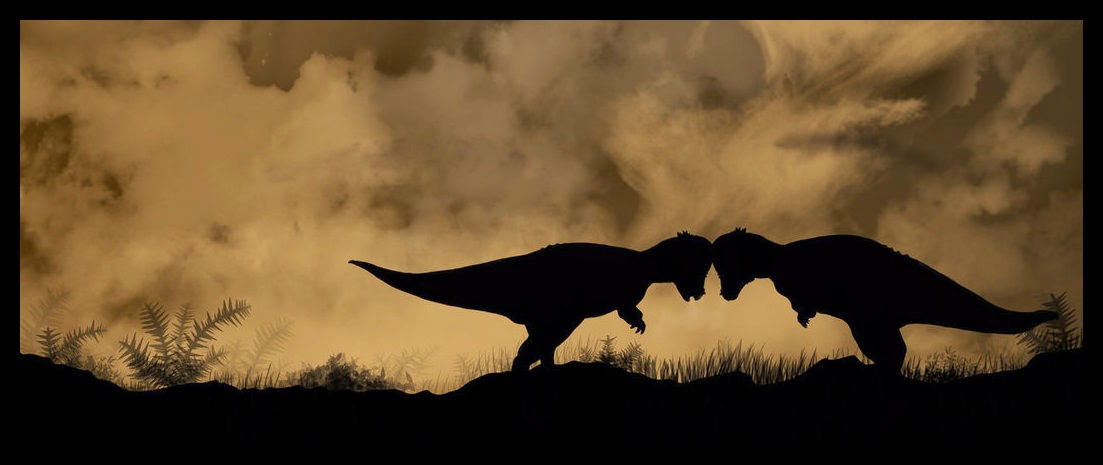
Pachycephalosaurus, the arch-type of the pachycephalosaurs, was first discovered in Montana. Its name means "thick headed lizard," and it fits the stereotype. Its known only by a number of large domed skull roofs and one nearly complete skull. This dinosaur's domed head could be up to nine inches thick. As to the purpose of the dome, speculation ran rampant until a couple years ago. Scientists analyzed the domed skulls and discovered indentations similar to those found on the bones of modern animals that head-butt; this has led scientists to conclude that Pachycephalosaurus did indeed butt heads. Males may have engaged in contests for females or territory. A secondary purpose of the skull could've been defensive: a blow from a charging Pachycephalosaurus could splinter bone and rupture organs.


This dinosaur's snout was covered with sharp spikes and dull horns. Its teeth were simple, nothing more elegant than triangular blades used to squash food. This has led paleontologists to speculate that it probably fed on a diet consisting mainly of soft vegetation.


Friday, January 16, 2015

Stygimoloch

Type Species: Stygimoloch spinifer
Classification: Dinosauria - Ornithischia - Marginocephalia - Pachycephalosauridae - Pachycephalosaurini
Time Period: late Cretaceous
Location: North America
Diet: Herbivore

A contemporary of my favorite dinosaur Parasaurolophus, my second favorite dinosaur is this wicked-looking devil to the left. His name means "the horned devil from the river of Hell," since (a) it's a horny bastard and (b) lots of its remains have been found in the Hell Creek Formation in Montana (the sty is inspired by the River Styx in classical mythology; moloch is derived from the pagan god by the same name, who would be identified by Judeao-Christian sources as "the Devil"). 

Stygimoloch was a medium-sized pachycephalosaur, dwarfed by its relative Pachycephalosaurus, the most widely-known pachy of them all! This guy's skull was decorated with horny bumps, piercing horns, and spikes; it also had the domed skull, a signature of the pachycephalosaurs. The horns ran from the base of the dome to the snout. The skull horns may have been used for butting enemies in dire circumstances, or maybe even in mating rituals, but because the horns are relatively weak, they were probably used solely for courtship displays. The horniest Stygi got the chic. Here's a size comparison between a human being and our Dino of the Week:


Interesting fact: rather recently, some paleontologists have started advocating the idea that Stygimoloch is simply the juvenile version of Pachycephalosaurus. That's an interesting take, but I hope they're wrong: I don't want to find a new 2nd Favorite Dinosaur.

Thursday, January 15, 2015

Triceratops

Type SpeciesTriceratops horridus
ClassificationDinosauria – Ornithischia – Marginocephalia – Ceratopsia – Neoceratopsia – Coronosauria – Ceratopsoidea – Ceratopsidae - Chasmosaurinae - Triceratopsini
Time Period: late Cretaceous
Location: North America
Diet: Herbivore

Triceratops was, in one word, massive. Stocky legs built like iron suspended its barrel-like rib-cage. Its known for its three horns (two protruding from above the eyes and a third from the nose), but not all Triceratops specimens have three horns. These burly creatures would dwarf any of us in their shadow:


The brow horns probably had a horny covering, and the base of the horns was actually hollow. This open space is called a sinus; it helped to cushion the brain when the horns were "in action," acting as a shock absorber. These sinuses are found in modern-day goats, sheep, and cows. And while Triceratops is often portrayed as the stereotypical ceratopsian, its skull frill was unique: most ceratopsians had fenestrae, or open-air cavities, in their frills that would be covered with skin in real life. These fenestrae helped keep the frill relatively light. Triceratops lacked such cavities, rendering its frill extremely heavy (this explains why its frill was smaller than most ceratopsians of its size). Their large beaks were powerful and scissor-like, and they would've been able to slice clean through a human arm. Their jaws were lined with tightly-knit teeth used for grinding their food. Triceratops wasn't the brightest bulb on the dinosaur tree; its brain was small for its size, even smaller than those of the "duck-billed" ornithopods, or carnivores.

Healed wounds in Triceratops' frill show that this dinosaur had a burly temperament. This hot-headed dinosaur probably fought against others in its herd, warring over females, territory, or leadership. The horns may have served the same purpose as antlers in modern-day moose: rather than attacking members of the own herd, Triceratops may have vied for dominance by locking horns with an adversary and "wrestling" until the weaker backed down. The horns would've been helpful not just in battling other males but also in defending itself against predators; recent models suggest that the horns packed such a punch that they could shatter solid bone. Nothing in the world today could withstand the charge of a bull Triceratops, so any hungry tyrannosaurs would have to think twice before taking the bitch on.

he's thinking, "I should've thought twice..."

Saturday, January 10, 2015

Chasmosaurus

Type Species: Chasmosaurus belli
Classification: Dinosauria – Ornithischia – Marginocephalia – Ceratopsia – Neoceratopsia – Coronosauria – Ceratopsoidea – Ceratopsidae - Chasmosaurinae
Time Period: middle Cretaceous
Location: North America
Diet: Herbivore

Chasmosaurus is recognized by the large fenestrae in its massive, rectangle-shaped frill. Most ceratopsians had hollow openings in their frill (fenestrae) that would be covered with skin in actual life, and Chasmosaurus has some of the largest fenestrae of any ceratopsians; hence the meaning of its name, "Chasm Reptile." Paleontologists speculate that the skin over the fenestrae was filled with blood vessels that enabled the skin to flush bright colors; this would be profitable for mating season, warding off predators, or even communicating among members of the herd.


Chasmosaurus had three horns on its face. The brow horns weresmall and blunt, perhaps serving as decorative pieces. The nasal horn seems built for serious business. Long and powerful, a jab from this horn could cut through the thickest flesh. Some specimens have smaller horns, and paleontologists speculate this is due to sexual dimorphism (phenotypic differences between males and females of a certain species). Chasmosaurus' skin was pebbly, rough, and thick like double-layered leather. Circular tubercles ran in regularly spaced rows across its skin, with smaller tubercles between the slender rows.
any depiction of Chasmosaurus sex is post-worthy. period.