Showing posts with label sauropodomorpha. Show all posts

Monday, July 6, 2020

Datousaurus


Type Species: Datousaurus bashanensis
Classification: Dinosauria – Saurischia – Sauropoda – Gravisauria - Eusauropoda - Mamenchisauridae
Time Period: Middle Jurassic
Location: China
Diet: Herbivore

Datousaurus was a sauropod that lived in China between the Callovian stage of the Middle Jurassic to the Oxfordian stage of the Late Jurassic. Only two partial skeletons have been discovered; neither of these had an articulated skull, but a detached skull has been attributed to the dinosaur. Because most sauropod remains include numerous individuals of different ages, implying a herd, Datousaurus ‘loner’ status has been intriguing; this has led some paleontologists to suggest that it was a ‘rogue’ sort of sauropod that didn’t live in family herds. Datousaurus was fifty feet snout-to-tail, and it had a deep, boxlike skull similar to that of the later Camarasaurus. During the Oxfordian stage, it lived alongside the sauropod Shunosaurus; though these two sauropods lived side-by-side, they likely practiced niche partitioning so that their foodstuffs didn’t overlap. Datousaurus’ elongated vertebrae gave it a higher reach than Shunosaurus, and its teeth were more spoon-shaped than those of the rival. Differences in teeth shape may indicate diets revolving around different plants. Other contemporaries of Datousaurus included the stegosaur Huayangosaurus and the theropod hunters Gasosaurus and Yangchuanosaurus

Cetiosaurus


Type Species: Cetiosaurus oxoniensis
Classification: Dinosauria – Saurischia – Sauropoda – Gravisauria - Eusauropoda - Cetiosauridae - Cetiosaurinae 
Time Period: Middle Jurassic
Location: Europe (England) 
Diet: Herbivore 

Cetiosaurus was the first sauropod to be named. In 1841 Sir Richard Owen named it the ‘whale lizard’, as the fossils were thought to belong to a marine organism something along the lines of an extremely large crocodile. We now know that Cetiosaurus was a land-dwelling sauropod who lived in a floodplain environment with open woodlands. It was a contemporary of the theropod hunter Megalosaurus, which may have preyed upon Cetiosaurus. This sauropod had a shorter tail and neck than most sauropods, and the forelimbs were roughly the same size as its hind limbs. It could grow to about fifty-two feet long and weighed around eleven tons. Its dorsal vertebrae – the bones along the back – had the original heavy build with limited air chambers, unlike the hollowed-out bones of later sauropods. 

Sunday, July 5, 2020

Cetiosauriscus


Type Species: Cetiosauriscus stewarti
Classification: Dinosauria – Saurischia – Sauropoda – Gravisauria - Eusauropoda
Time Period: Middle Jurassic
Location: Europe (England) 
Diet: Herbivore 

The sauropod Cetiosauriscus lived from the Callovian stage of the Middle Jurassic to the Oxfordian stage of the Late Jurassic. England at this point in history was a collection of low-lying islands jutting out of a shallow sea. Movement between the islands was possible, either by swimming or via land-bridges or by crossing in supremely shallow areas. Cetiosauriscus was discovered in the Oxford Clay Formation of England, which is known for its rich fossil record of fish and invertebrates. Scattered throughout this record of the prehistoric ‘Oxford Clay Sea’ are the remains of marine reptiles, oceangoing marine crocodylomorphs, and even terrestrial animals that suffered a watery grave. Cetiosauriscus is one of these creatures, and it didn’t suffer alone: the Oxford Clay has also given us fossilized remains of the theropod Eustreptospondylus, the primitive ankylosaur Sarcolestes, and the primitive stegosaur Lexovisaurus. Fossilized dinosaur eggs have also been preserved. 

Cetiosauriscus had a moderately long tail (even for sauropod standards), and its forelimbs were as long as its hind limbs. It could grow up to fifty feet in length and weighed between four and ten tons. Examination of its tail vertebrae show similarities to the later Diplodocus. Scientists speculate that the biconvex distal caudal vertebrae in sauropods were used for making whip-like cracking noises, as they were thin and delicate and not intended for impact (indeed, fractured or healed tail vertebrae are common). The purpose of the whip-like noises may have been to communicate between species or to ward off predators by practically bursting their ear drums if they got too close. 

Saturday, July 4, 2020

Omeisaurus

Type Species: Omeisaurus junghsiensis
Classification: Dinosauria – Saurischia – Sauropoda – Gravisauria - Eusauropoda - Mamenchisauridae 
Time Period: Middle Jurassic
Location: China 
Diet: Herbivore 

Fossils of several individual Omeisaurus were discovered in Sichuan Province, China, indicating that an entire herd had died and were buried together. These sauropods grew up to sixty-six feet in length and looked a lot like the later Mamenchisaurus (to whose ‘group’ they belong). Omeisaurus had an extremely long neck, stocky limbs, and a short body. The long neck may have been used to reach food high in the trees, or it may have been held horizontally over the ground to feed on large swathes of low-growing foliage. In this second manner of feeding, Omeisaurus would take a few steps forward and then swoop its neck over the vegetation, slowly creating a crescent-shaped swathe of devastated vegetation. This would’ve required less energy than high browsing. Omeisaurus tail was relatively short, and it may have included a club like the later Shunosaurus (though most scientists believe the club did indeed belong to Shunosaurus). 

Friday, July 3, 2020

Spinophorosaurus

Type Species: Spinophorosaurus nigerensis
Classification: Dinosauria – Saurischia – Sauropoda - Gravisauria 
Time Period: Middle Jurassic
Location: Africa (Niger) 
Diet: Herbivore 

The sauropod Spinophorosaurus was discovered in the late 2000s. The remains of two individuals were discovered in what had been, during the Bajocian-Bathonian stages of the Middle Jurassic, a river-valley system of lakes and rivers. Spinophosaurus was one of the first dinosaurs to have its skeleton 3D printed, and these prints were used to test locomotion and movement (by which it was determined that it was a high browser) and to experiment with different sauropod sex positions (naughty but fascinating!). Spinophosaurus reached thirty-eight feet in length, stood thirteen feet tall at the hips, and weighed around seven tons. It had tall shoulders and an elevated neck, giving it a vertical rather than horizontal posture (akin to the later Brachiosaurus and its contemporary Saharan sauropod Atlasaurus). Its braincase was short, deep, and broad, and it shows similarities between basal sauropodomorphs and more derived neosauropods. Its teeth were spoon-shaped and had large denticles at the top of the crown, an ancestral feature found in sauropods. Its neck is one of the most completely known among sauropods, and it contained thirteen vertebrae. The dorsal vertebrae had multiple air-filled internal chambers, something found in more derived sauropods such as the titanosauriforms and mamenchisaurids (two families which evolved them separately in cases of ‘convergent evolution’). Its tail was powered by strong musculature and had a rear section that was rigid due to long, overlapping chevron bones. 

Most artistic depictions of Spinophorosaurus (such the one below) depict it with two symmetrical pairs of long, sharp spikes reminiscent of those seen in the Jurassic stegosaurs. When Spinophorosaurus was uncovered, skeletal elements interpreted as a left and right osteoderms were found. These bones had a roundish base from which a spike-like projection protruded; the inner surfaces were rugose and concave. Although these bones were found in the pelvic region, the first scientists to study this sauropod believed that in life they were positioned at the tip of the tail, much like the later Shunosaurus had a tail club. However, this interpretation has recently fallen out of favor. Though the stiffening of Spinophorosaurus’ hind tail by elongated chevrons is observed in armored dinosaurs bearing clubs or spikes, Spinophorosaurus’ hindmost caudal vertebrae were likely too small to wield the weight of such a weapon. Later scientists pointed out that the osteoderms were not truly symmetrical and slightly differed in shape; this indicates that they didn’t form a pair but were more likely the mirror-inverted counterparts of one another. What, then, were these bones about? The current theory – embraced by further study in both 2015 and 2018 – is that these elements, which were found under the scapula, belonged to Spinophorosaurus’ clavicle. Although the image of a spike-wielding sauropod in prehistoric Saharan Africa is a wonderful one, it may not be reality. 


Atlasaurus

a pair of Atlasaurus on the African shores of Gondwana
Type Species: Atlasaurus imelakei
Classification: Dinosauria – Saurischia – Sauropoda - Gravisauria - Eusauropoda
Time Period: Middle Jurassic
Location: Africa (Niger) 
Diet: Herbivore 

In the Middle Jurassic, Saharan Africa was a lush mosaic of woodlands, rivers, and lakes – and the sauropod Atlasaurus called it home. Atlasaurus was named after the Atlas Mountains of Morocco, which were named after the Titan Atlas of Greek mythology who held up the sky. The species name A. imelakei comes from the Arabic ‘Imelake,’ the name of a giant. Atlasaurus looked a lot like the later Jurassic sauropod Brachiosaurus, but there are major differences: it had a larger skull, a shorter neck, a longer tail, and more elongated limbs. Its teeth were spoon-shaped. Atlasaurus has been estimated to have reached fifty feet in length and weighed over twenty tons. The positioning of its long legs indicate that it could reach relatively high speeds of locomotion compared to most sauropods. 

Jobaria

Type Species: Jobaria tiguidensis
Classification: Dinosauria – Saurischia – Sauropoda - Gravisauria - Eusauropoda
Time Period: Middle Jurassic
Location: Africa (Niger) 
Diet: Herbivore 

In the Middle Jurassic, Saharan Africa was a lush mosaic of woodlands, rivers, and lakes. One of the prime tenets was the primitive sauropod Jobaria. This sauropod was discovered in 1997 when a local Tuareg tribesman showed paleontologist Paul Sereno and a team of nineteen scientists a collection of strange bones that the Tuareg tribes-people associated with a mythical monster named Jobar. The exposed bones comprised a nearly complete skeleton that was part of a larger mass graveyard containing the remains of numerous adults and youngsters of a hitherto-unknown sauropod. One juvenile specimen bore bite-marks on its ribs that fit the teeth of Afrovenator, a prime carnivore of Jurassic northern Africa. An adult Jobaria grew to seventy feet in length head-to-tail and would’ve weighed up to twenty tons. The neck was relatively short with twelve vertebrae (more derived sauropods had eighteen or nineteen); the tail, too, was relatively short, and its vertebrae were simple, lacking the complex projections, scoops, and air-filled cavities of many later sauropods. The hind legs were strong enough to enable it to rear up on its hind legs to eat higher leaves, which it stripped with its spoon-shaped teeth. Jobaria’s position in the sauropod family tree is debated; some scientists consider it part of the ‘macronarians,’ giant sauropods distinguished by long necks and large snouts, while others consider it a ‘survivor sauropod’ that didn’t belong to any of the main sauropod families but which was a leftover of earlier times in sauropodomorph history. 

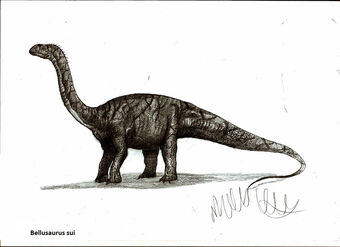
Bellusaurus

Type Species: Bellusaurus sui
Classification: Dinosauria – Saurischia – Sauropoda - Gravisauria - Eusauropoda - Neosauropoda - Macronaria
Time Period: Middle Jurassic
Location: China
Diet: Herbivore

Bellusaurus’ name is derived from the Latin bellus, meaning ‘small, delicate, beautiful.’ Seventeen individuals of this sauropod were found in a single quarry, suggesting that the herd had been killed in a flash flood. While this is tragic in its own right, the tragedy is compounded by the fact that they all appear to be juveniles. They measured only sixteen feet long, and bone studies indicate that they weren’t fully grown. One must wonder where the adults were when tragedy struck. Because there were no such things as ‘sauropod day cares’ (at least according to our understanding of sauropod social behavior), we must assume that the juveniles traveled with a much larger herd. One explanation is that when the flood hit, the larger adults were able to ‘weather the storm,’ but the lighter and smaller juveniles were swept away underfoot, only to be deposited miles away in a jumbled, rotting mess. A tragedy indeed. 


Thursday, July 2, 2020

Klamelisaurus


Type Species: Klamelisaurus gobiensis
Classification: Dinosauria – Saurischia – Sauropoda - Gravisauria - Eusauropoda
Time Period: Middle Jurassic
Location: China
Diet: Herbivore

Klamelisaurus was a medium-sized sauropod that reached around fifty feet in length and weighed up to five tons. Its remains consist of a partial skeleton lacking the skull. Most of the postcranial skeleton is complete, with only a few absences (the front of the neck, the left shoulder girdle, the forelimb, and the feet). Some scientists believe Klamelisaurus may be an adult version of a later Middle Jurassic sauropod named Bellusaurus

Monday, June 29, 2020

Ohmdenosaurus

Type Species: Ohmdenosaurus liasicus
Classification: Dinosauria – Saurischia – Sauropoda
Time Period: Early Jurassic
Location: Europe (Germany)
Diet: Herbivore

Ohmdenosaurus is one of the few fossilized sauropods found in Europe (most sauropods of the Jurassic tended to gather around the Tethys Sea coastlines). Ohmdenosaurus would’ve reached to about twenty-two feet in length and weighed around 2900 pounds. Its remains were found in an area that had been a series of islands in the region of modern-day Bohemia. These islands were rather large – much like Ireland being an ‘extended island’ of the British Isles – and sported a variety of environments, from seacoasts, river deltas, mangrove-like swamps, lagoons, and brackish waters. These islands were subject to monsoons and large scale rains, which resulted in a vast amount of insect fossils from this time period. Southern summers with humid south-west monsoons resulted in winters hit by dry northeast trade winds. Ohmdenosaurus lived among ocean-going crocodylomorphs such as Platysuchus and lizard-like marine rhynchosaurs such as Palaeopleurosaurus. The fossilized remains of the pterosaurs Campylognathoides and Dorygnathus have also been discovered in the environment.  


Sunday, June 28, 2020

Lingwulong

Type Species: Lingwulong shenqi
Classification: Dinosauria – Saurischia – Sauropoda – Gravisauria - Eusauropoda - Neosauropoda - Diplodocoidea - Flagellicaudata - Dicraeosauridae 
Time Period: Early Jurassic
Location: China
Diet: Herbivore

Lingwulong was a sauropod that lived in southern Laurasia sometime between the late Toarcian stage of the Early Jurassic and through the Bajocian stage of the Middle Jurassic. The fossils discovered belong to seven to ten individuals at different stages of growth, indicating that they belonged to a family herd. These sauropods had U-shaped snouts and grew up to fifty feet in length. Lingwulong is considered a ‘neosauropod’ (or ‘new sauropod’), the group to which most sauropods belong. The neosauropods are composed of two subgroups: Diplodocoidea and Macronaria. The neosauropods were the largest land animals to have ever lived, and Lingwulong is the earliest known of the group. It’s considered a dicraeosaurid, a ‘sister group’ to the diplodocids. Dicraeosaurids are differentiated from the diplodocids by their relatively small body size and short necks. 

Sunday, June 21, 2020

Kotasaurus

Type Species: Kotasaurus yamanpalliensis
Classification: Dinosauria - Saurischia – Sauropoda - Gravisauria - Eusauropoda
Time Period: Early Jurassic
Location: India
Diet: Herbivore

The thirty-foot-long and 2.5-ton Kotasaurus was one of the earliest known sauropods. It shared its habitat with another sauropod, Barapasaurus. The fossilized remains of twelve individuals – lacking, unfortunately, their skulls (though two teeth have been recovered!) – were discovered in India. The remains were jumbled together in what had been a Jurassic riverbed, and scientists speculate that the herd drowned in a flash flood and was washed to a bend in the river where they were deposited en masse. Only the heaviest bones remained to be fossilized, for after the floodwaters receded, their carcasses would’ve been set upon by scavengers. The absence of skulls isn’t surprising, since skulls are very loosely connected to the spine and thus easily wrenched free and taken to other locations for eating. Kotasaurus had a heavy body, a long neck and tail, columnar limbs, spoon-shaped teeth, and a horizontal posture.  


Saturday, June 20, 2020

Aardonyx

Type Species: Aardonyx celestae
Classification: Dinosauria - Saurischia – Prosauropoda
Time Period: Early Jurassic
Location: Africa
Diet: Herbivore

The twenty-foot-long Aardonyx is known from the jumbled bones of two individuals, both estimated at less than ten years of age. Aardonyx is beloved among paleontologists because it shows numerous ‘transitional features’ between the prosauropods of the Late Triassic and the sauropods of the Early Jurassic in terms of anatomy and feeding habits. Dr. Matthew Bonnan, who has studied Aardonyx at length, notes, “We already knew that the earliest sauropods and near-sauropods would be bipeds. What Aardonyx shows us, however, is that walking quadrupedally and bearing weight on the inside of the foot is a trend that started very early in these dinosaurs, much earlier than previously hypothesized… On a scientific level, it’s really fulfilling to have a hypothesis on how you think dinosaurs got large, then to test that in the field and get back these kind of data – a new dinosaur – that really does start to fill in some of those anatomical gaps.” 

Aardonyx had an elongated neck leading to a small head, a massive torso, and long tail. It was primarily bipedal, though it could drop down on all fours, and the forearm bones were in the process of evolving into the pillar-like legs of the sauropods. The leg bones were beginning to interlock for more strength at the price of flexibility, but flexibility isn’t good when you’re bearing a lot of weight, as the weight could cause the joints to buckle and break. Aardonyx gives us a snapshot of the genesis of the skeletal structures that would enable later sauropods to reach behemoth weights up to eighty tons. Aardonyx lacked the fleshy cheeks of the prosauropods which enabled them to open their mouths wide to pick at choice leaves; Aardonyx would’ve had a ‘bulk-browsing’ method of eating, in which it stripped leaves off the branches wholesale, just as was the case with sauropods. 


Friday, June 19, 2020

Leonerasaurus


Type Species: Leonerasaurus taquetrensis
Classification: Dinosauria - Saurischia – Prosauropoda
Time Period: Late Triassic or Early Jurassic
Location: Argentina
Diet: Herbivore

Leonerasaurus was an unusually small prosauropod from Argentina. It’s been dated to the Late Triassic or Early Jurassic (the exact dating of the rock formation is in question). It’s known from a single subadult specimen that would’ve grown to about seven and a half feet head-to-tail and reached about three feet in height. Though most of its anatomy is solidly like those of prosauropod, its teeth share a mixture of sauropod and prosauropod characteristics: while its teeth are spoon-shaped like those of more derived sauropods, the surface texture is more similar to that of most prosauropods. 

Xingxiulong


Type Species: Xingxiulong chengi
Classification: Dinosauria - Saurischia – Prosauropoda
Time Period: Early Jurassic
Location: China
Diet: Herbivore

The Hettangian stage Early Jurassic prosauropod Xingxiulong was discovered in 2017 when three specimens – two adults and a juvenile (known to be such because of the third’s incomplete vertebral fusion) – were uncovered in China. The adults measured thirteen to sixteen feet in length and reached between three feet and nearly five feet in height (making them relatively small when compared to their large sauropodomorph cousins). Despite their small size, they share similarities with the titanic sauropods: like sauropods, their hips, femurs, and feet were particularly robust. These suggest that it had a large gut and high body mass. However, it would’ve also been capable of assuming a bipedal stance, as sauropodan adaptations to quadrupedalism – such as relatively longer forelimbs – aren’t present. Because of the assemblage of fossils, it’s assumed these ‘small-sized’ prosauropods traveled in family groupings. 

Lufengosaurus

Type Species: Lufengosaurus young
Classification: Dinosauria - Saurischia - Prosauropoda
Time Period: Early Jurassic
Location: China
Diet: Herbivore

Lufengosaurus lived in China during the Early Jurassic around 190 million years ago. It’s similar to its contemporary Yunnanosaurus: both were prosauropods that reached to about twenty-three feet in length and half a ton in weight (though some more recent estimates have put Lufengosaurus at up to thirty feet long); both had small heads with long necks and tails, tubby torsos, and both were quadrupedal; both had deep and broad snouts; both had shorter forelimbs than hind-limbs (though Lufengosaurus’ were slightly shorter relative to the hind-limbs); and both were named only one year apart by the same paleontologist. These coincidences prompted theories that Lufengosaurus and Yunnanosaurus were the same dinosaur with intraspecies variation. This would mean that Yunnanosaurus was actually a variant species of Lufengosaurus, since Lufengosaurus was named first, in 1941. Others have built upon this theory and added a twist: both Lufengosaurus and Yunnanosaurus may have been different species of the earlier Massospondylus. Thus all three would be species of Massospondylus, and paleontological textbooks would need to be rewritten. These theories have fallen out of vogue, however, due to the fact that Lufengosaurus and Yunnanosaurus differ wildly when it comes to their teeth. Whereas Yunnanosaurus teeth were narrow and spoon-shaped (like those of sauropods), Lufengosaurus retained the widely-spaced, leaf-shaped teeth common to early sauropodomorphs. 

Lufengosaurus was herbivorous, though – like all prosauropods – it had sharp claws, especially on its thumbs, and sharp, serrated teeth. This has led some to speculate that Lufengosaurus – along with its prosauropod kin – was omnivorous. However, modern herbivorous iguanas have sharp teeth and claws, and they don’t eat meat. The strongest theory is that Lufengosaurus was herbivorous, using its sharp claws for defense or for raking foliage from trees. This prosauropod has made headlines at least twice after its discovery. First, its fossilized embryos have been discovered, and they represent the earliest evidence of vertebrate soft tissue preservation. Second, in 2017 scientists discovered 195-million-year-old collagen protein (used in connective tissues) in the fossilized rib bone of a Lufengosaurus

Thursday, June 18, 2020

Barapasaurus


Type Species: Barapasaurus tagorei
Classification: Dinosauria - Saurischia - Sauropoda - Gravisauria - Cetiosauridae
Time Period: Early Jurassic
Location: India
Diet: Herbivore

The Early Jurassic sauropod Barapasaurus is one of the few dinosaurs that have been discovered on the Indian subcontinent. It lived during the Sinemurian and Pliensbachian stages of the Early Jurassic (199-182 million years ago). Over 300 Barapasaurus fossils were discovered in the Godavari Valley of south central Indian in 1961. The remains included no skulls or feet, but it was determined that the remains belonged to at least six individuals. The fossils were found among large tree trunks scattered over an area of over 250 square meters. Paleontologists speculate this assemblage was due to a catastrophic flood, in which the herd of these early sauropods in a conifer forest were swept away – along with the trunks of their foodstuffs – and deposited a distance away. As they began to decompose, the bones began to disarticulate, and the disarticulated skull bones were removed by the residual water streams because they were light. 


Barapasaurus was an early sauropod, and it exemplified many of the derived sauropod traits. An adult reached about sixty-six feet from head-to-tail, and it had the elongated neck and tail of the sauropods. It had a short trunk and columnar limbs. Its vertebrae show signs of transitioning to the type seen in more derived sauropods: though Barapasaurus had rudimentary weight-saving scoops or hollows common in sauropods, they were less prevalent than those found in later sauropods. Only three whole teeth and three crowns have been discovered. The largest known tooth is 5.8 centimeters in height. Its teeth were spoon-shaped and show wrinkled enamel, as is the case with derived sauropods. Barapasaurus was likely slow and plodding, feeding for many hours a day. It stripped vegetation and swallowed its food without chewing, allowing gastroliths in the gut to break down the food for processing. 

Tuesday, June 2, 2020

Pantydraco


Type Species: Pantydraco cadacus
Classification: Dinosauria - Saurischia - Sauropodomorpha
Time Period: Late Triassic
Location: Wales, United Kingdom
Diet: Omnivore

Pantydraco lived during the Late Triassic in the semi-humid wetlands of South Wales. Its name has nothing to do with undergarments; ‘panty’ is short for the Welsh word Pant-y-ffynnon, signifying hollow of the spring/well and refers to the quarry in South Wales where it wound found (‘draco’ means ‘dragon’). 

This Welsh dragon is known from a single species belonging to a juvenile. It had a long tail that was broad at the hips and tapered towards the end. It had a pointed head and strong jaws filled with well-developed teeth. It’s suspected to have been omnivorous, in the transitional phase between herbivorous and carnivorous lifestyles. Its forelimbs were shorter than its hindlimbs, and it was bipedal. Its clawed hands were designed for grasping and had three movable digits with a withered fourth. Though the juvenile’s estimated length is around three feet, adults may have been up to ten feet long. An adult would’ve weighed about 110 pounds. 

an artist's rendition of a feathered Pantydraco