Showing posts with label thyreophora. Show all posts

Friday, October 15, 2021

Kentrosaurus


Type Species
: Kentrosaurus aethiopicus
Classification: Dinosauria – Ornithischia – Thyreophora – Stegosauria – Stegosauridae
Time Period: Late Jurassic 
Location: Africa
Diet: Herbivore

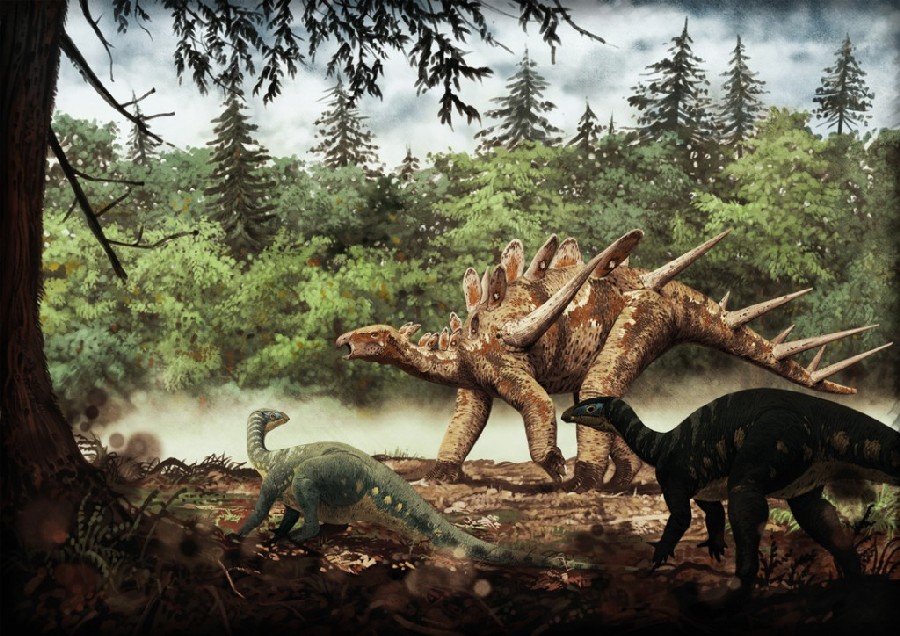
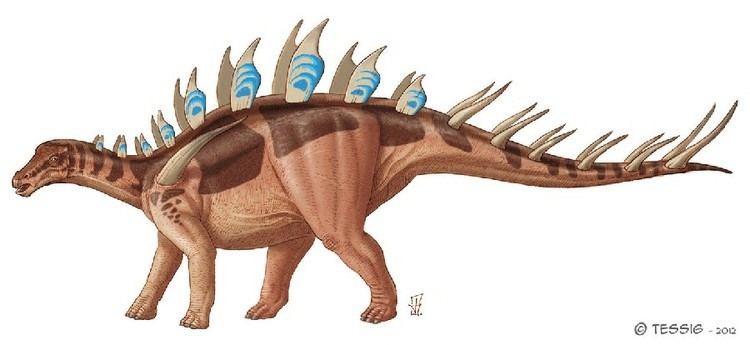
The African stegosaur Kentrosaurus was closely related to Stegosaurus though it was half its size, clocking in at around fifteen feet in length. Kentrosaurus had a small, elongated head with a beak that it used to sever tough plant material to be digested in its barrel-like gut. Its skin was covered in bony osteoderms, and it had small plates on its neck. These small plates were dwarfed by the plates that ran along its back in a series of fifteen rows. These plates were elongated with a thickened section in the middle, as if they were modified spines, and they were probably covered in horn. These plates gradually merged into spikes on the hip and tail. The longest spikes were on the end of its tail, and it would’ve used its thagomizer as a defensive weapon. It also had a long spike on each shoulder. Because the thigh bones come in two different types, it’s likely that males and females differed in their stoutness (a case of sexual dimorphism). 

Kentrosaurus is considered a low-browsing herbivore, and it likely roamed the thick conifer forests of northern Africa’s inland woodlands and may have even browsed on foliage in the less-lush coastal regions. If it ate while on all fours, it could reach up to five and a half feet off the ground; if it was capable of rearing back on its hind legs to eat, it could access food up to eleven feet off the ground. As a low-browser, it would’ve shared its niche with the iguanodont Dysalotosaurus, leaving the higher foliage to macronarian sauropods such as Giraffatitan

Kentrosaurus shared its environment with predators such as Elaphrosaurus, Allosaurus, and Veterupristisaurus. The former was too small to pose any real threat, but Allosaurus and Veterupristisaurus were a different story. The forty-foot-long Veterupristisaurus was the top predator in its environment, and it’s likely that Kentrosaurus would’ve faced-off with this predator on numerous occasions, and those plates and spikes would’ve come in good use. Scientists estimate that it could swing its tail up to speeds of 30 miles per hour, and continuous rapid swings wouldn’t only discourage attacks but could deal massive damage as the spikes ripped open its attackers’ skin, punctured its soft tissues, and broke ribs or facial bones. Repeated blows could even fracture the sturdy limb bones of the stoutest predator. With its ability to pivot quickly round on its hind legs, it would be adept at keeping its spikes pointed towards the attacker. If Kentrosaurus were a herding animal, the family group may have ‘circled-the-wagons’ with their tail spikes facing out to ward off curious predators. Such a wall of spikes would be virtually impenetrable and would likely be enough to discourage even a pack of hungry Allosaurus. Some scientists speculate that a lone Kentrosaurus, when under attack, might have charged backwards, using its tail spines like a spear, much in the manner of modern porcupines. 

Saturday, April 24, 2021

Alcovasaurus


Type Species
: Alcovasaurus longispinus
Classification: Dinosauria – Ornithischia – Thyreophora – Stegosauria – Stegosauridae – Dacentrurinae
Time Period: Late Jurassic
Location: North America
Diet: Herbivore

The North American stegosaur Alcovasaurus grew up to eighteen feet in length; this medium-sized stegosaur would’ve been a low browser in prehistoric North America. Its main enemies would’ve included the theropods Allosaurus, Torvosaurus, and perhaps Ceratosaurus. Much of Alcovasaurus’ anatomy is unknown, but because what we do know is similar to the African Kentrosaurus, most reconstructions make it similar to its African contemporary. Alcovasaurus was originally identified as a species of Stegosaurus. This classification was questioned, however, due to five significant anatomical differences, not least its long dermal spikes. Alcovasaurus had two tail spike pairs as its thagomizer that were slender and elongated and ninety percent of the thighbone length. Some scientists argued that these larger spike pairs weren’t indicative of a different species but of sexual dimorphism used for display; perhaps, the argument went, male stegosaurs had flashier thagomizers. Other scientists argued that this stegosaur was less closely related to Stegosaurus and had more affinity with the African Kentrosaurus. Serious studies of this dispute were hampered when the type specimen was damaged by water after a pipe burst at the University of Wyoming; studies couldn’t continue until more specimens were recovered. Recently those scientists who argued for Alcovasaurus being a different genera won out, and Alcovasaurus is now differentiated from its contemporary Stegosaurus.

Friday, January 22, 2021

Miragaia


Type Species: Miragaia longicollum
Classification: Dinosauria – Ornithischia – Thyreophora – Stegosauria – Stegosauridae – Dacentrurinae
Time Period: Late Jurassic 
Location: Europe 
Diet: Herbivore

The stegosaur Miragaia was closely related to its contemporary cousin Dacentrurus. Miragaia could grow eighteen to twenty feet in length and would clock in at around two tons. Paired triangular plates ran down the midline of its neck; these plates were asymmetrical with a convex outer side and a concave inner side. They were obtuse but lightly hooked at the front. A long, narrow, and straight spike has been preserved; some paleontologists believe this was a shoulder-spike seen in some stegosaurs, but others believe it was part of the tail. Miragaia’s tail anatomy isn’t known, but it’s usually reconstructed with a four-spiked thagomizer like that seen in its near relatives. Because Miragaia’s front limbs were almost as high as the rear limbs, its overall posture was more horizontally level to the ground than what we find in most other stegosaurs, whose bodies slope down to the ground so that their heads were better situated for low browsing.

Miragaia is noteworthy for its elongated neck, which was built by seventeen vertebrae. It had the longest neck of any known stegosaur, and most scientists believe this represents the pinnacle of a trend toward longer necks in stegosaurs. Thyreophorans – the dinosaur clade to which stegosaurs belong – originally had nine neck vertebrae, and one of the most basal stegosaurs, the Chinese Huayangosaurus of the Middle Jurassic, had nine, as well. While more advanced stegosaurs such as Stegosaurus had twelve or thirteen vertebrae, Miragaia outdoes them – and it even outdoes most sauropods of its time. Only a few Chinese sauropods – such as Euhelopus, Mamenchisaurus, and Omeisaurus – had as many neck vertebrae as Miragaia; most sauropods of the Late Jurassic had only twelve to fifteen widely-spaced vertebrae. Scientists have come up with two explanations for Miragaia’s elongated neck. The first holds that it developed due to sexual selection: if longer-necked stegosaurs of this species were seen as more attractive, then it makes sense that necks would get longer over time. Another theory, and one which is more likely, is that the long neck developed as an aide to niche partitioning. Miragaia lived alongside the obviously low-browsing Dacentrurus (and Stegosaurus may have even ocean-hopped to reside in Portugal); because of this, these two species would be in direct confrontation. Niche partitioners coexist by eating different foods, and it may be that Miragaia evolved as a medium-browser, able to reach foods inaccessible to other stegosaurs. Its limb structure, which indicates a shift away from a low-browsing stance, supports this theory for the origin of Miragaia’s long neck. 

Tuesday, January 12, 2021

Hesperosuchus

a mother Hesperosaurus defends its child against an Allosaurus


Type Species: Hesperosaurus mjosi  
Classification: Dinosauria – Ornithischia – Thyreophora – Stegosauria – Stegosauridae
Time Period: Late Jurassic 
Location: United States 
Diet: Herbivore

The infamous Stegosaurus wasn’t the only stegosaur roaming the Morrison during the Kimmeridgian; its slightly smaller cousin Hesperosaurus was present, too (though it was likely more closely related to Dacentrurus of Europe). Hesperosaurus grew up to twenty to twenty-two feet in length – making it slightly smaller than Stegosaurus, which could grow up to thirty feet long – and weighed two to three tons. Like Stegosaurus it had two rows of plates running along its back; asymmetrical bases imply that the rows were staggered rather than symmetrical. Hesperosaurus’ plates were wider than those of Stegosaurus but not as tall, and its skull was deeper than that of its Morrison kin. Like Stegosaurus, Hesperosaurus had a four-spiked thagomizer on its tail; the front pair was thicker than the latter pair, and the latter were more horizontally directed towards the rear. Hesperosaurus’ tail spikes angled slightly backwards, pointing away from the body, implying that they were used in defense against predators such as Allosaurus and Torvosaurus. At least one Allosaurus specimen shows damage to its vertebrae that seems delivered by a stegosaur’s tail spike. 

CAT-scans on Hesperosaurus’ plates show that they had thin but dense outer walls and were filled with thick but spongy bone. This bone shows signs of being remodeled during the growth process. The plate bones were supplied with blood via long and wide arterial vessels. CAT-scans of the tail spikes show that they have thicker walls than the plates, and the interior spongy hollows are smaller. Each spike had a single artery that ran along the longitudinal axis. Skin impressions from Hesperosaurus give us a glimpse of what it looked like enfleshed: a part of the lower flank preserves rows of small, hexagonal, non-overlapping convex scales; higher on the flank are rosette structures with large central scales. Impressions of the back plates show no scales but a smooth surface with low parallel ridges; these likely represent the horn sheath covering the plate, and if so, these represent the first direct proof of such plate sheaths in stegosaurs. The horn sheath on the plates indicate that they had a defensive function, as the horn layer would not only strengthen the bony plate but give it sharp cutting edges. Simultaneously, the display function seems plausible, as these plates would likely be brightly colored in real life. Horn sheaths are a blow to those who believe the plates served a thermoregulatory function, as the sheaths would’ve hampered the plates’ ability to thermoregulate; however, the theory cannot be wholly rejected, for some cattle and ducks use horns and beaks to dump excess heat despite horn coverings. 

Sunday, July 26, 2020

Gargoyleosaurus

a Gargoyleosaurus takes its stand against an Allosaurus 

Type Species: Gargoyleosaurus parkpinorum
Classification: Dinosauria – Ornithischia – Thyreophora – Ankylosauria – Nodosauridae
Time Period: Late Jurassic 
Location: North America
Diet: Herbivore   

Gargoyleosaurus is one of the earliest ankylosaurs, and it shared its habitat with another smaller ankylosaur named Mymoorapelta. Gargoyleosaurus had an eleven-inch skull and reached up to thirteen feet from its head to tail. As a nodosaur it lacked the tail club associated with many ankylosaurs. Gargoyleosaurus was a common low-browsing herbivore in the western United States, as three specimens have been discovered. Its armor – consisting of plates and conical spikes across its back and sides – would’ve served as a deterrent against contemporary predators such as Allosaurus

Mymoorapelta

a Mymoorapelta is flanked by a pair of Ceratosaurus

Type Species: Mymoorapelta maysi
Classification: Dinosauria – Ornithischia – Thyreophora – Ankylosauria – Nodosauridae 
Time Period: Late Jurassic 
Location: North America
Diet: Herbivore   

Mymoorapelta is one of the earliest ankylosaurs along with Gargoyleosaurus. Mymoorapelta was the first Jurassic ankylosaur to be discovered in North America, though scientists ponder its exact placement within Ankylosauria. Because it lacks a tail club, most scientists consider it to be a nodosaur (one of the ‘branches’ of Ankylosauria; these ankylosaurs lacked tail clubs). Some believe it to be a polacanthine ankylosaur, a ‘middle-ground’ between the clubbed ankylosaurs and the non-clubbed nodosaurs; others believe it is a basal ankylosaur that doesn’t fit into Ankylosauridae nor Nodosauridae. At only ten feet in length snout-to-tail, Mymoorapelta is the smallest herbivore known from the Morrison Formation. It was a low browser, feeding on ferns and cycads and other low-growing plants. Its armor would’ve given it decent protection against predators such as Allosaurus, but it may not have been an invulnerable deterrence, as predators were known to go after the plated and spiked stegosaurs in the same environment. Being so small and low to the ground, Mymoorapelta’s first line of defense may have been one of hiding among foliage to escape detection. 

a cast of well-preserved Mymoorapelta remains

Thursday, July 23, 2020

Yingshanosaurus


Type Species: Yingshanosaurus jichuanensis
Classification: Dinosauria – Ornithischia – Thyreophora – Stegosauria – Stegosauridae – Stegosaurinae 
Time Period: Late Jurassic
Location: China 
Diet: Herbivore   

The Chinese stegosaur Yingshanosaurus was on the smaller side of things, growing to about sixteen feet snout-to-thagomizer, and it’s known for a pair of broad, wing-like spines on its shoulders that were flat like the bony plates on its back. These shoulder spines had large, flat, trapezoidal bases; after a sudden kink, they were reduced to a more narrow straight shaft that remained flat but with a protruding ridge on the outer side. The plates on its back were small and relatively low, and they were triangular or fin-shaped. The largest plates were only about five inches high and seven and a half inches long. These plates were uniformly flat with a rough, veined surface. As a low browser, Yingshanosaurus plodded through the Jurassic forests of prehistoric China munching on cycads and ferns. 

Wednesday, July 22, 2020

Dacentrurus

Type Species: Dacentrurus armatus
Classification: Dinosauria – Ornithischia – Thyreophora – Stegosauria – Stegosauridae – Dacentrurinae
Time Period: Late Jurassic
Location: Europe 
Diet: Herbivore   

The stegosaur Dacentrurus was initially discovered in England, though fragmentary remains have been found in France, Spain, and Portugal (in which fossilized eggs are attributed to Dacentrurus), indicating a wide distribution among the islands and archipelagos of northeastern Laurasia. We know that stegosaurs were regularly attacked by large theropods in North America (Stegosaurus and Allosaurus had a long-running feud), and it’s believed that Dacentrurus faced similar opposition on its own turf; however, the precise identity of its larger theropod assailants is unknown, as the larger European theropods of the Jurassic date back to the Early and Middle Jurassic (such as Dubreuillosaurus and Poekilopleuron). If the Oxfordian theropod Metriacanthosaurus continued into the Kimmeridgian, it's likely it and Dacentrurus duked it out a time or two. This stegosaur was initially named Omosaurus, but since that name had already been given to a species of extinct crocodile, the name was changed to Dacentrurus.

a Dacentrurus defends against a Ceratosaurus (never mind these two likely didn't coexist!)

Dacentrurus was a large, heavily-built stegosaur that grew up to thirty-two feet in length and clocked in around five and a half tons. It had a broad gut and a massive rump. Its hind-limbs were short, but the forelimbs were long; thus Dacentrurus had the same general proportions as its North American cousin Stegosaurus, though their ‘plate armor’ was different. Dacentrurus had eight pairs of triangular plates that ran from the neck to the end of the hip; these ‘double-rowed’ plates were followed by four pairs of large spikes that ran down to the thagomizer. Dacentrurus’ stagomizer consisted of four more pairs of spikes that pointed to the side, and these tail spikes had sharp cutting edges on the front and rear sides. The arrangement of ‘plate and spike’ armor is reminiscent of its African cousin Kentrosaurus. Though Dacentrurus is often portrayed with a spike growing near the shoulder, this is artistic license based upon the fact that many primitive stegosaurs – i.e. those that had a mix of both plates and spikes – employed such shoulder spikes. 

Tuesday, July 14, 2020

Tuojiangosaurus


Type Species: Tuojiangosaurus multispinus
Classification: Dinosauria – Ornithischia – Thyreophora – Stegosauria – Stegosauridae 
Time Period: Late Jurassic
Location: China
Diet: Herbivore 

The Chinese stegosaur Tuojiangosaurus was discovered in the Shaximiao Formation of China. This bone-bed dates back to the Oxfordian stage of the Late Jurassic, and this stegosaur is one of three stegosaurs found in the environment (the other two are Chialingosaurus and Chungkingosaurus). Contemporaries of Tuojiangosaurus included sauropods such as Mamenchisaurus and Shunosaurus, theropods such as Yangchuanosaurus and Gasosaurus, and ornithischians such as the early ornithopod Agilisaurus and a heterodontosaur holdout from the earlier Jurassic known as Tianyulong

Tuojiangosaurus is the best understood Chinese stegosaur. It was medium-sized at twenty-three long and six and a half feet tall. Its weight has been estimated to nearly three tons. It had a narrow and low head, bulky body, and short limbs. It had at least twenty-five teeth, and these teeth had a thick base that merged at the inside into a triangular vertical median ridge. Tuojiangosaurus had two rows of plates along its spine; these became taller over the hip region. Those at the neck and front trunk were rounded or pear-shaped, while the plates towards the rear became more triangular and pointed. All the plates had a thickened central section, as if they were modified spikes. Tuojiangosaurus seems to have had seventeen pairs of these plates and spikes. 

The thagomizer at the end of its tail consisted of two outward-pointing robust spikes on each end of the tail. These were angled at 45 degrees towards the vertical, indicating they were used for defensive purposes. The plates wouldn’t have been any protection against predators, as they’re too weak and brittle to protect against a powerful bite. Because they’re not adapted enough for thermoregulation purposes, it seems the best explanation towards their purpose is that of inter-species display. Many stegosaur species coexisted, and recognizing one’s own kind would’ve been aided by particular arrangements and shapes of plates between species. 

the shoulder spikes on this Tuojiangosaurus are hypothetical, based on the fact that
many primitive stegosaurs - and its contemporaries - had shoulder spikes. None were found
with the remains we have.


Gigantspinosaurus


Type Species: Gigantspinosaurus sichuanensis
Classification: Dinosauria – Ornithischia – Thyreophora – Stegosauria 
Time Period: Late Jurassic
Location: China
Diet: Herbivore 

The Chinese stegosaur Gigantspinosaurus lived in the Oxfordian stage of the Late Jurassic. It was small-sized, reaching fourteen feet snout-to-tail and weighing 1500 pounds. It’s distinctive appearance consists of relatively small dorsal plates – a testament to its primitive, basal placement within stegosauria – and extremely large shoulder spines, even larger than those of the later African Kentrosaurus. These shoulder spines were twice the length of the shoulder blades on which they rested. The plates on the neck are small and triangular, and the head would’ve been relatively large with thirty teeth in the lower jaws. Its hips were broad and narrow, its forelimbs were robust, and the low neural spines of the four sacral vertebrae and the first tail vertebra were fused into a single plate. Scutes were discovered among the remains, but their placement on the body is unknown. Skin impressions show rosettes with a central pentagonal or hexagonal scale surrounded by thirteen to fourteen ridged smaller square, pentagonal or hexagonal scales. Gigantspinosaurus was a low browser that likely fed on ferns and cycads. 

Chungkingosaurus


Type Species: Chungkingosaurus jiangbeiensis
Classification: Dinosauria – Ornithischia – Thyreophora – Stegosauria – Huayangosauridae 
Time Period: Late Jurassic
Location: China
Diet: Herbivore 

The stegosaur Chungkingosaurus was discovered in the Shaximiao Formation of China. This bone-bed dates back to the Oxfordian stage of the Late Jurassic, and this stegosaur is one of three stegosaurs found in the environment (the other two are Chialingosaurus and Tuojiangosaurus; some believe Chialingosaurus and Chungkingosaurus are the same animal). Contemporaries of Chungkingosaurus included sauropods such as Mamenchisaurus and Shunosaurus, theropods such as Yangchuanosaurus and Gasosaurus, and ornithischians such as the early ornithopod Agilisaurus and a heterodontosaur holdout from the earlier Jurassic known as Tianyulong

Two Chungkingosaurus specimens have been found; both were adults, with one thirteen feet long and the other sixteen and a half feet long. This could be a matter of sexual dimorphism, though stegosaurs have traditionally been interpreted as loners (though some stegosaurs may have traveled in small family groups). Chungkingosaurus resembled in many ways its larger contemporary Tuojiangosaurus, which lived in the same environment. Subtle differences between the two include the fact that Chungkingosaurus was smaller, had a deeper snout and front lower jaws (resulting in a high, narrow skull), and non-overlapping teeth with less pronounced denticles. Chungkingosaurus’ hips and humerus are more primitive than more derived stegosaurs. The deep skull may be a relict of a primitive trait or an adaptation for supporting stronger muscles for eating tougher vegetation. This stegosaur had two rows of plates and spikes on its back; they were arranged in pairs, but the total number is unknown (though most scientists believe it had fourteen rows of plates). Its plates were thickened in the middle, as if they were modified spikes, and they resemble those of Tuojiangosaurus. The thagomizer – the tail spikes used as a defensive weapon – are known only from one specimen. Its thagomizer consisted of two pairs of obliquely vertical stout spikes. It may have had a third pair towards the front of the back two pairs that was present when the specimen was discovered but lost during the excavation. A unique feature of its thagomizer was an additional pair of spikes at the very end of the tail; these were long, thin spikes oriented horizontally, giving the full thagomizer a ‘pin-cushion’ spike array. 

Chialingosaurus

Type Species: Chialingosaurus kuani
Classification: Dinosauria – Ornithischia – Thyreophora – Stegosauria – Stegosauridae 
Time Period: Late Jurassic
Location: China
Diet: Herbivore 

The stegosaur Chialingosaurus is known from a single specimen that includes a partial skeleton (but no skull); the fossilized remnants include six vertebrae, the coracoids, the humeri, a right radius, and three spines. It was found in the Shaximiao Formation in China, and is one of three stegosaurs known from the environment. The other stegosaurs are Chungkingosaurus and Tuojiangosaurus. Some scientists believe Chialingosaurus and Chungkingosaurus are actually the same genera, rendering the stegosaur count of Shaximiao to two. Contemporaries of Chialingosaurus included sauropods such as Mamenchisaurus and Shunosaurus, theropods such as Yangchuanosaurus and Gasosaurus, and ornithischians such as the early ornithopod Agilisaurus and a heterodontosaur holdout from the earlier Jurassic known as Tianyulong. Chialingosaurus was a small and slender stegosaur that reached only about thirteen feet in length. Like all stegosaurs it was a low browser, likely munching on ferns and cycads. Reconstructions of Chialangosaurus’ armor is guesswork, but it have generally been modeled after Kentrosaurus. Some paleontologists believe that the arrangement of the spines on the hip and tail – and possibly the shoulders – would’ve been used both for defense against predators and as a means of display, differentiating this genera from the similarly-sized Chungkingosaurus

Saturday, July 4, 2020

Huayangosaurus


Type Species: Huayangosaurus taibaii
Classification: Dinosauria – Ornithischia – Thyreophora – Stegosauria - Huayangosauridae
Time Period: Middle Jurassic
Location: China 
Diet: Herbivore 

In 1979 the fossilized remains of twelve stegosaurs were discovered in China. These belonged to a new species that lived during the Bathonian and Callovian stages of the Middle Jurassic. Huayangosaurus looked a lot like its later cousin, Stegosaurus, though it was much smaller at only fifteen feet in length. Huayangosaurus lived twenty million years before Stegosaurus and is one of the earliest known stegosaurs (though Europe’s Lexovisaurus beats it to the punch by a few million years). Huayangosaurus’ primitive placement in the stegosaur ‘family tree’ is evidenced by several factors. First, this stegosaur had a broader skull than later stegosaurs, and its skull had a small opening in front of each eye and another small opening in each half of the lower jaw (these openings are absent in later stegosaurs); second, Huayangosaurus had fourteen teeth at the front of its snout (seven on each side), and later stegosaurs lacked these teeth; third, Huayangosaurus had long front limbs that were three-quarters longer than the back limbs, whereas later stegosaurs had forelimbs that were much shorter than the hind limbs; and fifth, the armor plates that ran in two rows along Huayangosaurus’ back were narrower and thicker than those adorning the backs of its later relatives.

a pair of Huayangosaurus with a herd of Omeisaurus
Huayangosaurus nevertheless resembles a ‘proper’ stegosaur. It had the distinctive double row of plates that characterize all stegosaurs; these plates began at its neck and ran along its back until it reached the hips, at which point the plates were replaced with four spikes. After this series of spikes, the plates resumed until they ended with two pairs of long spikes extending horizontally near the end of the tail. These spikes were undoubtedly defensive weapons against such predators as Gasosaurus and Monolophosaurus. Huayangosaurus, like the earlier Lexovisaurus, had two spikes that protruded either from the hips or the shoulders. The exact placement is unknown, with artistic depictions representing either location depending on artistic fancy. The current general consensus is that, as in Lexivosaurus, they were placed on the shoulders; in this case, they would serve as defensive weapons: if an assailant attacked from the front or from the forward side quadrants, Huayangosaurus could ‘thrust’ its spikes deep into the adversary’s hide. In a world without medicine, such penetrating attacks into an enemy’s organs could often be lethal. Only the most foolish of predators would attempt to make a meal out of the armed stegosaur. 

Friday, July 3, 2020

Isaberrysaura


Type Species: Isaberrysaura mollensis
Classification: Dinosauria – Ornithischia – Thyreophora – Stegosauria 
Time Period: Middle Jurassic
Location: South America (Argentina) 
Diet: Herbivore 

Isaberrysaura was an early stegosaur of South America that had yet to be regulated to fully quadrupedal locomotion. It grew to sixteen to twenty feet in length, making it slightly longer than its Laurasian contemporary Lexovisaurus. Its teeth were heterodont (of different types), and similarities in dentition with modern iguanas indicates that Isaberrysaura may have been omnivorous. We know for certain that it ate plants, because the type specimen was discovered with its stomach contents fossilized for science’s delight. Within the rib cage, a mass of fossilized seeds was discovered, the first preserved meal uncovered in a basal ornithischian. Two types of seeds were present: the largest were preserved in three layers (an outer fleshy sarcotesta, the sclerotesta, and an inner layer that may have been the nucellus); these larger seeds belonged to a cycad of the Zamiineae family. The origin of the smaller seeds are unknown. Because the cycad seeds were swallowed whole, rather than chewed, we can infer that they were in the first stages of digestion in Isaberrysaura’s gut. Scientists speculate that its gut contained enzyme-producing bacteria that aided in the digestion of the tougher seed material. 

Lexivosaurus


Type Species: Lexivosaurus durobrivensis
Classification: Dinosauria – Ornithischia – Thyreophora – Stegosauria
Time Period: Middle Jurassic
Location: Europe (England, France)
Diet: Herbivore

Lexivosaurus is the first of the ‘standard-looking’ stegosaurs that would rise to prominence in the Late Jurassic. It’s been found in England and France, though it’s more common in England. The first discoveries were made near Lyons, France, and the fossil remains belonged to three individuals and included isolated bits of bones, plates, and spikes. The three individuals were a range of ages, from juvenile to adult, indicating a family group. Lexivosaurus’ name comes from the Lexovix people, one of the ancient Gallic tribal groups from what is now Lyons, France. 

Lexivosaurus was smaller than later stegosaurs, but it was ‘small’ only in comparison: it reached sixteen and a half feet long and weighed around two tons. It was a low-browsing herbivore that roamed the wooded islands that were scattered throughout the shallow seas of prehistoric Europe. Lexivosaurus has back plates that run from its neck to its tail; these plates are narrow and short rather than broad and angular, and it had several pairs of long spikes on the tail. These were likely defensive weapons used against attacking predators such as Magnosaurus, Poekipleuron, and Megalosaurus. Another defensive weapon was the meter-long shoulder spikes that projected from the upper rear part of the front limbs, below the characteristic twin rows of bony plates along the top of its neck and back. While older reconstructions of Lexivosaurus place the spines on the hips, modern paleontologists tend to put them on the shoulders. These spikes may have been used as visual displays – for courtship, fighting rival mates, or species identification – or they may have been defensive weapons, like the tail spikes. If a predator were attacking from the front, Lexivosaurus could thrust itself forward, driving the spikes into the flesh of its assailant. 

Monday, June 29, 2020

Emausaurus


Type Species: Emausaurus ernsti
Classification: Dinosauria – Ornithischia – Thyreophora   
Time Period: Early Jurassic
Location: Europe (Germany)
Diet: Herbivore

Emausaurus is the only known thyreophoran from the Toarcian stage of the Early Jurassic. The remains discovered in Germany belonged to a juvenile whose length was estimated at eight feet and likely weighed 150 to 200 pounds. Adults (whose remains have not been found) may have reached as long as thirteen feet and weighed around 750 pounds. Emausaurus resembled the earlier Laurasian thyreophoran Scelidosaurus, and it was covered in bony armor – called osteoderms. It had at least one spike in its armor. Though infants and juveniles may have been capable of a bipedal stance (perhaps to reach higher foliage), adults were probably confined to a quadruped stance, and as such they were low browsers. The juvenile Emausaurus was recovered in an ancient seashore environment, maybe even a lagoon, and the same rock-beds show Toarcian fauna such as insects, bivalves, sea snails, ammonites, and fish. The remains of marine reptiles, crocodylomorphs, and at least two sauropods have been discovered in the rock-beds, as well. 

Tuesday, June 23, 2020

Scutellosaurus


Type Species: Scutellosaurus lawleri
Classification: Dinosauria – Ornithischia – Thyreophora
Time Period: Early Jurassic
Location: North America
Diet: Herbivore

Scutellosaurus has been a riddle in the ornithischian family tree for a long while. Like its European contemporary Scelidosaurus, it’s been paraded as the kind of dinosaur that could’ve evolved into one of the later, better-known groups of thyreophorans (the armored ankylosaurs and plated stegosaurs). Most scientists consider it a common ancestor of both groups and believe it to be closely related to Scelidosaurus and the later Early Jurassic Emausaurus. Though some want to place it in the Scelidosauridae family along with Scelidosaurus, currently it’s viewed as an earlier, more basal thyreophoran (Scelidosaurus is larger and seems to be a more ‘evolved’ thyreophoran with more similarities to the later ankylosaurs and stegosaurs). 

Scutellosaurus is known from two partial skeletons from Arizona. The remains included portions of the skull and lots of detached bony plates called scutes (from which this dinosaur gets its name). The scutes came in a variety of shapes: some were triangular wedges, others were low cones, some were lopsided trimpets, and still others were curved like horns. Hundreds of detached scutes have been found, but because they were detached, the exact pattern on the body is unknown. Scientists estimate that a single individual had anywhere between two hundred and four hundred of these scutes embedded in its skin like small, raised shields. 

a flock of Scutellosaurus flee a pack of Dilophosaurus
Scutellosaurus was relatively small, growing between four to six and a half feet long, and weighing twenty-fifty pounds despite its light armor. It stood about twenty inches tall at the hips. It was small, slim, and long, and it had an unusually long tail, perhaps to counterbalance the weight of its armor. It probably ran rapidly on all fours since the front limbs had broad, sturdy paws. It could rear up on its longer hind limbs to eat higher plant-stuffs, but it’s unlikely that it could’ve run very well bipedally, since its armor would’ve made it top-heavy. Its mouth had a narrow, beak-like front, and its jaws contained several broad incisors and a row of fluted, leaf-shaped cheek teeth designed to crush plant material. Its head was protected by low bony plates. Scientists speculate that, like the similar-sized heterodontosaurs of the Early Jurassic, this early thyreophoran was gregarious in nature, traveling in ‘family flocks’. 

a Scutellosaurus taking a break with an Early Jurassic turtle


Scelidosaurus

Type Species: Scelidosaurus harrisonii
Classification: Dinosauria – Ornithischia – Thyreophora – Scelidosauridae
Time Period: Early Jurassic
Location: British Isles and North America
Diet: Herbivore

The thirteen-foot-long herbivore Scelidosaurus lived among the scattered wooded islands of the British Isles during the Sinemurian and Pliensbachian stages of the Early Jurassic some 196-183 million years ago. It also 'migrated' into northern Laurasia, or North America as we know it now, as its remains have recently been discovered in Arizona. Scelidosaurus is the most completely known dinosaur from the British Isles and the only classified dinosaur from Ireland. For 150 years Scelidosaurus has been the epicenter of a fierce debate regarding its placement in the ‘dinosaur family tree.’ Some scientists argue that it’s an early ankylosaurs; others that it’s an early stegosaur; still others that it’s an early thyrophoroidean; and still others insist that it’s its own type of dinosaur with its own family, the Scelidosauridae (perhaps along with Scutellosaurus and Emausaurus). The general consensus at the moment – though, you can imagine, it is quite subject to change! – is that it belongs to Scelidosauridae, a thyreophoran sister taxon of the ankylosaurs and stegosaurs.

Scelidosaurus had a small head with a horny, beak-like front to its mouth. It was quadrupedal, with its rear legs longer and stronger than its forelegs, so that its back sloped up towards the hips (these features would be developed and exaggerated later on by the stegosaurs). Though primarily a low browser feasting on ferns and cycads, Scelidosaurus may have been able to rear up on its hind limbs to reach higher foliage such as conifers, but this is debated; even if it could become bipedal for eating, it wouldn’t have been able to move on two legs, and the bipedal stance would be awkward and cumbersome. Thus, though Scelidosaurus was capable of a bipedal stance, it likely only did so when the environment forced its hand. Scelidosaurus fed with a puncture-crush system of tooth-on-tooth action with a precise up-and-down jaw movement without the teeth actually touching each other. The later stegosaurs, with their primitive teeth and simple jaws, fed likewise. Its tail was stiff due to tendons that lay alongside its backbone and which became ossified with bony minerals.

The most notable facet of Scelidosaurus was the ‘light armor’ it sported: its neck, body, and tail were studded with small, pebble-like scales and large bony plates called scutes. The scutes were generally longer at the front of the body and diminishing in size towards the rear, especially at the thighs. Scelidosaurus’ bony armor – called osteoderms – are seen in modern crocodiles, armadillos, and some lizards. Compared to the later ankylosaurs, Scelidosaurus’ armor was ‘amateur hour,’ for it lacked continuous plating, spikes, or pelvic shields. Scelidosaurus’ osteoderms were arranged in horizontal parallel rows down the length of its body. The osteoderms ranged in both size and shape. Most were smaller or larger oval plates with a high keel on the outside, the highest point of the keel positioned more to the rear. Some scutes were small, flat and hollowed-out at the inside. The larger keeled scutes were aligned in regular horizontal rows. There were three rows of these along each side of the torso. The scutes of the lowest lateral row were more conical, rather than the blade-like osteoderms of Scutellosaurus. Between these main series, one or two rows of smaller oval keeled scutes were present. There were in total four rows of large scutes on the tail: one at the top midline, one at the midline of the underside, and one at each tail side. Whether the midline tail scutes continued over the torso and neck to the front is unknown and unlikely for the neck, though Scelidosaurus is often pictured this way. The neck had at each side two rows of large scutes. The osteoderms of the lower neck row were very large, flat, and plate-like. The first osteoderms of the top neck rows formed a pair of unique three-pointed scutes directly behind the head. These points seem to have been connected by tendons to the rear joint processes. Some of the latest Scelidosaurus specimens show different osteoderms, including scutes on which the keel is more like a thorn or spike. These specimens also have little horns on the rear corners of the head. These differences could indicate a variant species of Scelidosaurus or could be instances of sexual dimorphism (i.e. perhaps males and females had different patterns and types of armor). 

Scelidosaurus is one of the dinosaurs for which we have skin impressions. Between the bony scutes, Scelidosaurus had rounded, non-overlapping scales like the modern Gila monster. Between the large scutes, very small, flat ‘granules’ of bone were distributed within the skin. In the later ankylosaurs, these small scutes may have developed into larger scutes, fusing into the multi-osteodermal plate armor seen in species such as Ankylosaurus


Saturday, January 17, 2015

Edmontonia

a club would be REALLY helpful right about now
Type Species: Edmontonia longiceps
Classification: Dinosauria-Ornithischia-Thyreophora-Ankylosauria-Nodosauridae
Time Period: late Cretaceous
Location: North America
Diet: Herbivore

Edmontonia's back was covered with an array of small, flat keeled (ridged) plates. Its neck and shoulders were plastered with larger keeled plates, and spines protruded forward from its shoulders. More spines ran along the sides of its body, tapering to nothing near its hips. This short, squat dinosaur no doubt used the spines as protection against predators and may have also used them in courtship displays or to battle with other males for potential mates. Edmontonia was a smaller dinosaur, but I'd still be willing to ride him:


Wednesday, January 14, 2015

Ankylosaurus

Type Species: Ankylosaurus magniventris
Classification: Dinosauria-Ornithischia-Thyreophora-Ankylosauria-Ankylosaurini
Time Period: Cretaceous
Location: North America
Diet: Herbivore

Ankylosaurus was the tank of the dinosaur era. If James Gurney's Dinotopia took place in 1930s Europe, Ankylosaurus would be leading the German blitzkrieg. The entire top side of its body was heavily armored with thick, oval plates embedded in its leathery skin. Two rows of spikes ran along its body, large horns protruded from the back of its head, and it sported a club-like tail. My attempt at describing it reminds me of the weird apocalyptic angels seen in the biblical literature; this animal is just that weird. Only its underside was un-plated, so that flipping it over was the only way to wound it (and that would be quite a feat, seeing as these guys weighed in around 3.5 tons!). Ankylosaurus had four short legs (though the hind legs were larger than the front), a short neck, and a wide skull with a teeny brain. Its diet consisted of plants (that's an herbivore, if you're into the lingo), and it probably had a fermentation compartment in its bowels to aid in the digestion of the tough plant material (this would make it fart a lot). Ankylosaurus trackways have been found in Bolivia, showing that these animals could run at a "decent jog," according to Christian Meyer, a Swiss paleontologist working at the site (speed estimates are made by measuring the distance between the footprints, the animal's leg length, the pattern of the tracks, and other factors that are tossed into an algorithm). 

Because a complete skeleton has yet to be found, estimates on Ankylosaurus' size vary; a conservative estimate puts it at about 25-35 feet long and six feet wide and four feet tall. As far as weight goes, we're talking 3-4 tons. Here's what the "fused lizard" would look like facing off an African elephant.

the ankylosaurus would win