Friday, July 3, 2020

Jobaria

Type Species: Jobaria tiguidensis
Classification: Dinosauria – Saurischia – Sauropoda - Gravisauria - Eusauropoda
Time Period: Middle Jurassic
Location: Africa (Niger) 
Diet: Herbivore 

In the Middle Jurassic, Saharan Africa was a lush mosaic of woodlands, rivers, and lakes. One of the prime tenets was the primitive sauropod Jobaria. This sauropod was discovered in 1997 when a local Tuareg tribesman showed paleontologist Paul Sereno and a team of nineteen scientists a collection of strange bones that the Tuareg tribes-people associated with a mythical monster named Jobar. The exposed bones comprised a nearly complete skeleton that was part of a larger mass graveyard containing the remains of numerous adults and youngsters of a hitherto-unknown sauropod. One juvenile specimen bore bite-marks on its ribs that fit the teeth of Afrovenator, a prime carnivore of Jurassic northern Africa. An adult Jobaria grew to seventy feet in length head-to-tail and would’ve weighed up to twenty tons. The neck was relatively short with twelve vertebrae (more derived sauropods had eighteen or nineteen); the tail, too, was relatively short, and its vertebrae were simple, lacking the complex projections, scoops, and air-filled cavities of many later sauropods. The hind legs were strong enough to enable it to rear up on its hind legs to eat higher leaves, which it stripped with its spoon-shaped teeth. Jobaria’s position in the sauropod family tree is debated; some scientists consider it part of the ‘macronarians,’ giant sauropods distinguished by long necks and large snouts, while others consider it a ‘survivor sauropod’ that didn’t belong to any of the main sauropod families but which was a leftover of earlier times in sauropodomorph history. 

Isaberrysaura


Type Species: Isaberrysaura mollensis
Classification: Dinosauria – Ornithischia – Thyreophora – Stegosauria 
Time Period: Middle Jurassic
Location: South America (Argentina) 
Diet: Herbivore 

Isaberrysaura was an early stegosaur of South America that had yet to be regulated to fully quadrupedal locomotion. It grew to sixteen to twenty feet in length, making it slightly longer than its Laurasian contemporary Lexovisaurus. Its teeth were heterodont (of different types), and similarities in dentition with modern iguanas indicates that Isaberrysaura may have been omnivorous. We know for certain that it ate plants, because the type specimen was discovered with its stomach contents fossilized for science’s delight. Within the rib cage, a mass of fossilized seeds was discovered, the first preserved meal uncovered in a basal ornithischian. Two types of seeds were present: the largest were preserved in three layers (an outer fleshy sarcotesta, the sclerotesta, and an inner layer that may have been the nucellus); these larger seeds belonged to a cycad of the Zamiineae family. The origin of the smaller seeds are unknown. Because the cycad seeds were swallowed whole, rather than chewed, we can infer that they were in the first stages of digestion in Isaberrysaura’s gut. Scientists speculate that its gut contained enzyme-producing bacteria that aided in the digestion of the tougher seed material. 

Lexivosaurus


Type Species: Lexivosaurus durobrivensis
Classification: Dinosauria – Ornithischia – Thyreophora – Stegosauria
Time Period: Middle Jurassic
Location: Europe (England, France)
Diet: Herbivore

Lexivosaurus is the first of the ‘standard-looking’ stegosaurs that would rise to prominence in the Late Jurassic. It’s been found in England and France, though it’s more common in England. The first discoveries were made near Lyons, France, and the fossil remains belonged to three individuals and included isolated bits of bones, plates, and spikes. The three individuals were a range of ages, from juvenile to adult, indicating a family group. Lexivosaurus’ name comes from the Lexovix people, one of the ancient Gallic tribal groups from what is now Lyons, France. 

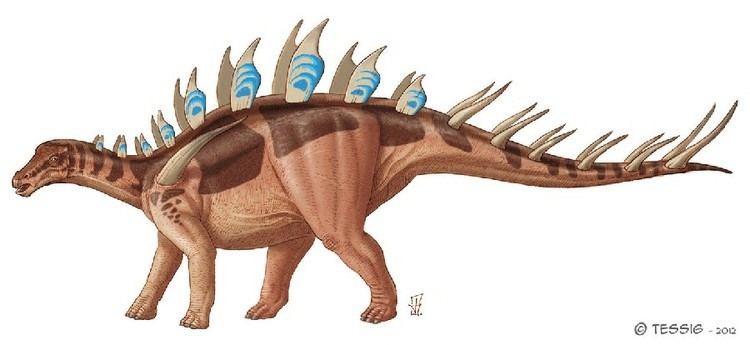
Lexivosaurus was smaller than later stegosaurs, but it was ‘small’ only in comparison: it reached sixteen and a half feet long and weighed around two tons. It was a low-browsing herbivore that roamed the wooded islands that were scattered throughout the shallow seas of prehistoric Europe. Lexivosaurus has back plates that run from its neck to its tail; these plates are narrow and short rather than broad and angular, and it had several pairs of long spikes on the tail. These were likely defensive weapons used against attacking predators such as Magnosaurus, Poekipleuron, and Megalosaurus. Another defensive weapon was the meter-long shoulder spikes that projected from the upper rear part of the front limbs, below the characteristic twin rows of bony plates along the top of its neck and back. While older reconstructions of Lexivosaurus place the spines on the hips, modern paleontologists tend to put them on the shoulders. These spikes may have been used as visual displays – for courtship, fighting rival mates, or species identification – or they may have been defensive weapons, like the tail spikes. If a predator were attacking from the front, Lexivosaurus could thrust itself forward, driving the spikes into the flesh of its assailant. 

Bellusaurus

Type Species: Bellusaurus sui
Classification: Dinosauria – Saurischia – Sauropoda - Gravisauria - Eusauropoda - Neosauropoda - Macronaria
Time Period: Middle Jurassic
Location: China
Diet: Herbivore

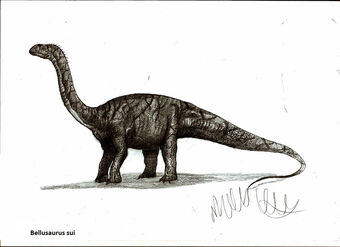
Bellusaurus’ name is derived from the Latin bellus, meaning ‘small, delicate, beautiful.’ Seventeen individuals of this sauropod were found in a single quarry, suggesting that the herd had been killed in a flash flood. While this is tragic in its own right, the tragedy is compounded by the fact that they all appear to be juveniles. They measured only sixteen feet long, and bone studies indicate that they weren’t fully grown. One must wonder where the adults were when tragedy struck. Because there were no such things as ‘sauropod day cares’ (at least according to our understanding of sauropod social behavior), we must assume that the juveniles traveled with a much larger herd. One explanation is that when the flood hit, the larger adults were able to ‘weather the storm,’ but the lighter and smaller juveniles were swept away underfoot, only to be deposited miles away in a jumbled, rotting mess. A tragedy indeed. 


Thursday, July 2, 2020

Klamelisaurus


Type Species: Klamelisaurus gobiensis
Classification: Dinosauria – Saurischia – Sauropoda - Gravisauria - Eusauropoda
Time Period: Middle Jurassic
Location: China
Diet: Herbivore

Klamelisaurus was a medium-sized sauropod that reached around fifty feet in length and weighed up to five tons. Its remains consist of a partial skeleton lacking the skull. Most of the postcranial skeleton is complete, with only a few absences (the front of the neck, the left shoulder girdle, the forelimb, and the feet). Some scientists believe Klamelisaurus may be an adult version of a later Middle Jurassic sauropod named Bellusaurus. 

Condorraptor

Type Species: Condorraptor currumili
Classification: Dinosauria – Saurischia – Theropoda
Time Period: Middle Jurassic
Location: South America
Diet: Carnivore

In 2007 Condorraptor became the world’s first Middle Jurassic theropod skeleton found with intact joints. The skeletal remains indicate that Condorraptor was a fast-running hunter. It’s known from only one specimen, and these belonged to a juvenile. Scientists extrapolate that Condorraptor may have reached up to fifteen feet in length as an adult and weighed around a quarter of a ton. As a midsized theropod, Condorraptor likely preyed upon other dinosaurs such as early sauropods and the smaller ornithischian dinosaurs of its day. 

Wednesday, July 1, 2020

Magnosaurus


Type Species: Magnosaurus nethercombensis
Classification: Dinosauria – Saurischia – Theropoda - Carnosauria - Megalosauroidea -  Megalosauria - Megalosauridae - Eustreptospondylinae
Time Period: Middle Jurassic
Location: Europe (England)
Diet: Carnivore

Magnosaurus used to be classified as an early species of Megalosaurus. Along with many other as-yet-unidentified theropods, it was part of the ‘Megalosaurus Wastebin,’ a drop-off for disarticulated theropod remains that look a lot like Megalosaurus but may be other creatures. In 2010 a Cambridge University paleontologist Roger Benson took a detailed look at the remains of a juvenile theropod and realized that, because the jawbone had a number of characteristics unseen in any other dinosaur (including Megalosaurus), they must belong to an entirely new genera. Thus Magnosaurus, its own kind of theropod, came into existence. Magnosaurus reached about thirteen feet in length and weighed between five hundred pounds and half a ton, and it hunted among the wooded islands of prehistoric England. It may be one of the first ‘stiff-tailed’ tetanuran theropods, making it a distant ancestor of the better-known Cretaceous theropods Tyrannosaurus and Velociraptor.