Saturday, January 24, 2015

Pachycephalosaurus


Type Species: Pachycephalosaurus wyomingesis
Classification: Dinosauria - Ornithischia - Marginocephalia - Pachycephalosauridae - Pachycephalosaurini
Time Period: late Cretaceous
Location: North America
Diet: Herbivore

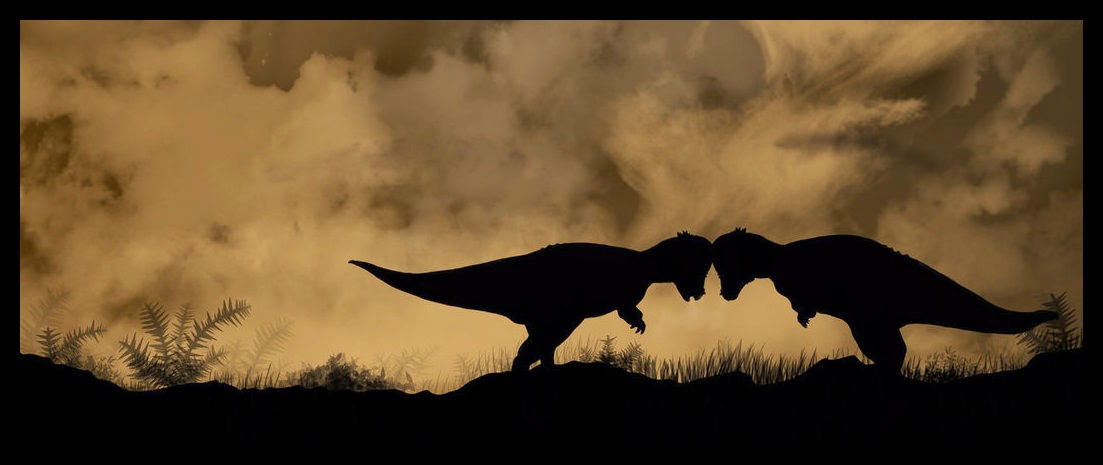
Pachycephalosaurus, the arch-type of the pachycephalosaurs, was first discovered in Montana. Its name means "thick headed lizard," and it fits the stereotype. Its known only by a number of large domed skull roofs and one nearly complete skull. This dinosaur's domed head could be up to nine inches thick. As to the purpose of the dome, speculation ran rampant until a couple years ago. Scientists analyzed the domed skulls and discovered indentations similar to those found on the bones of modern animals that head-butt; this has led scientists to conclude that Pachycephalosaurus did indeed butt heads. Males may have engaged in contests for females or territory. A secondary purpose of the skull could've been defensive: a blow from a charging Pachycephalosaurus could splinter bone and rupture organs.


This dinosaur's snout was covered with sharp spikes and dull horns. Its teeth were simple, nothing more elegant than triangular blades used to squash food. This has led paleontologists to speculate that it probably fed on a diet consisting mainly of soft vegetation.


Sunday, January 18, 2015

Tyrannosaurus

Type Species: Tyrannosaurus rex
Classification: Dinosauria - Saurischia - Theropoda - Tetanurae - Tyrannosauridae
Time Period: late Cretaceous
Location: North America
Diet: Carnivore

From storybooks to kids' drawings, to professional art and worldwide cinematic hits, Tyrannosaurus rex is worshiped and revered as the titan of the dinosaur world. Its very name means "tyrant lizard," and media harps upon this fact. Remains of more than fifty skeletons have been discovered throughout North America, in Wyoming, Colorado, Texas, South Dakota, and as far north as Alberta, Canada. Tyrannosaurus was one of the largest carnivores of dinosauria (the current title of carnivorous heavyweight champ goes to Spinosaurus, and Tyrannosaurus ranks tenth). Although he's lost the championship title, Tyrannosaurus remains an imposing figure:


"What are we to make of those scrawny forearms?" The first Tyrannosaurus skeletons were incomplete, and paleontologists speculated that it had larger three-fingered arms like that of Allosaurus. When complete skeletons were found, including the world-famous "Sue", it became apparent that Tyrannosaurus did indeed have (what appeared to be) scrawny arms. Biomechanical analyses of the arms, however, imply they may not have been that scrawny after all. The cortical bones in the arm were thick, implying an ability to withstand intense pressure and heavy loads; the bicep muscles would've been able to lift 439 pounds. I don't know any human who can do that, and if humans were as large as Tyrannosaurus, this dinosaur would still be able to lift 3.5 times as much weight as a human would. These arms weren't scrawny at all; despite their size, they could be used to grapple and hold prey while the jaws went to work. It's been said that what matters isn't size but how you use it; Tyrannosaurus' arms are a Case Study of this fact. 

fighting over a carcass? or defending a kill? Read more below!
An ongoing debate regarding Tyrannosaurus has to do with its diet: "Was it a scavenger or a predator?" Some have argued that because of its short forearms and awkward build, it wouldn't have made a good predator; if it fell, for instance (as might happen in a contest against an armored herbivore), it would have a hell of a time getting back to its feet. For a time the evidence lie with those arguing for a scavenging diet, but lately this has gone out-of-style. Tyrannosaurus seems built for hunting: its eyes face forward and not to the side as with most carnivorous dinosaurs, allowing for depth and distance to be gauged; the strong yet lightweight skull made for a formidable attack; and its muscular jaw, with specialized hinges that allowed the bottom jaw to be lowered unusually low to take in large chunks of meat, could've served as a "grappling hook" against struggling prey. Its legs were extremely muscular; at a walking pace, it could move close to five miles an hour, and it could top thirty miles per hour in a brisk jog. The nail in the coffin of the Pro-Scavengers came in 2013; up to that point, there were hints here-and-there that Tyrannosaurus was a hunter: bones with bite marks, broken teeth near skeletal remains, and foot tracks indicating pursuits. In 2013, however, a remarkable find was made: a Tyrannosaurus rex tooth was found embedded in the tailbone of a hadrosaur. The hadrosaur's tailbone had healed over the tooth, indicating that it had escaped its predator to live another day. 

an Anatotitan Rodeo!

Saturday, January 17, 2015

Edmontonia

a club would be REALLY helpful right about now
Type Species: Edmontonia longiceps
Classification: Dinosauria-Ornithischia-Thyreophora-Ankylosauria-Nodosauridae
Time Period: late Cretaceous
Location: North America
Diet: Herbivore

Edmontonia's back was covered with an array of small, flat keeled (ridged) plates. Its neck and shoulders were plastered with larger keeled plates, and spines protruded forward from its shoulders. More spines ran along the sides of its body, tapering to nothing near its hips. This short, squat dinosaur no doubt used the spines as protection against predators and may have also used them in courtship displays or to battle with other males for potential mates. Edmontonia was a smaller dinosaur, but I'd still be willing to ride him:


Cryolophosaurus

Type Species: Cryolophosaurus elliotti
Classification: Dinosauria-Saurischia-Theropoda-Tetanurae
Time Period: early Jurassic
Location: Antarctica
Diet: Carnivore

The remains of Cryolophosaurus were found in the barren colds and wastes of the Trans-Antarctic Mountains. Although some paintings of this carnivore depict it tramping through snow and shaking its weird crest this way and that in a blizzard, Antarctica in the early Jurassic wasn't where it is today; it was nearer the equator, and part of a larger continent; the climate would've been warmer and the land replete with temperature forests. Cryolophosaurus has been called the "Elvis Presley" of the dinosaurs because of its twin set of backward-sweeping crest that resembles Presley's infamous hairdo. Cryolophosaurus sported small horns adjacent to the backward-sweeping crests, Measuring at about twenty feet long, Cryolophosaurus was to the early Jurassic what Tyrannosaurus was to the late Cretaceous: the King of the Tyrants. 


Although Cryolophosaurus was the largest predator of its day (the much larger Allosaurus wouldn't come until millions of years later), paleontologists speculate that it may have been a scavenger rather than a hunter; the crests were relatively frail, and the ferocity of the hunt would likely damage the crests. Because the crest bones have been intact, it makes more sense that Cryolophosaurus scavenged for its food. One large skeleton of this dinosaur indicates it may have been a voracious eater: what looks like an herbivorous dinosaur's rib was found wedged inside the bones of the Cryolophosaurus' throat! Some postulate that this dinosaur choked on its dinner; others argue that the rib belongs to Cryolophosaurus and was maneuvered into that weird position after death. As to the purpose of this dinosaur's crest, it probably served as courtship decoration. 

And just for shits and giggles, here's a cool video of a pair of Cryolophosaurus battling it out!


Parasaurolophus


Type Species: Parasaurolophus walkeri
Classification: Dinosauria - Ornithischia - Ornithopoda - Hadrosauridae - Lambeosaurinae - Parasaurolophini
Time Period: Late Cretaceous
Location: North America
Diet: Herbivore

What better way to kick off "Dinosaurs of 2015" with the sexiest dinosaur of them all? Parasaurolophus is my all-time favorite dinosaur, and she's had cameos in The Land Before TIme and the Jurassic Park movies. She was a big bitch, too:

and that's for a full-grown adult. She'd look MUCH bigger to me.
Her name means "like Saurolophus," since both dinosaurs had trombone-like crests protruding from the backs of their heads. But whereas Saurolophus' crest was solid bone, Parasaurolophus' crest was hollow and lined with looping nasal cavities running from the nostril on the crest to its throat. You can get a sense of this dinosaur's size (as well as the size of its swooping trombone-like crest) in this clip from The Lost World:


As to the purpose of the crest, paleontologists have offered lots of theories (none testable, of course). There's the theory that it was a snorkel for underwater swimming, that it could've been the "entrance" to an air container so that Parasaurolophus could submerge beneath the waves. I don't think this is too likely: despite the proliferation of movies presenting this dinosaur in the water, research within the last decades has shown how the water pressure wrapping around these titanic dinosaurs when submerged would've been strong enough to crush their ribs. Others theories include its intensification of scent, it was an area used to "cool off" the brain, or that it was a horn used for social display, identifying its age and sex and herd membership. 

The most widely-accepted theory is that the crests were used to emit sounds. These noises would warn of impending danger, attract potential mates, or signal to other members of the herd. The nasal loops within the crest lend credit to this theory. A vocal organ such as a voice-box would make the sounds, and the sound would then be pushed through the hollow tubes within the crest, giving the creature a deep, bellowing rumble. Scientists have mapped the nasal loops and have run simulations to determine what the sounds would've been like:


That's the trumpeting of a dinosaur.
A cry out of place in this world.
A howl very, very alien.

Friday, January 16, 2015

Stygimoloch

Type Species: Stygimoloch spinifer
Classification: Dinosauria - Ornithischia - Marginocephalia - Pachycephalosauridae - Pachycephalosaurini
Time Period: late Cretaceous
Location: North America
Diet: Herbivore

A contemporary of my favorite dinosaur Parasaurolophus, my second favorite dinosaur is this wicked-looking devil to the left. His name means "the horned devil from the river of Hell," since (a) it's a horny bastard and (b) lots of its remains have been found in the Hell Creek Formation in Montana (the sty is inspired by the River Styx in classical mythology; moloch is derived from the pagan god by the same name, who would be identified by Judeao-Christian sources as "the Devil"). 

Stygimoloch was a medium-sized pachycephalosaur, dwarfed by its relative Pachycephalosaurus, the most widely-known pachy of them all! This guy's skull was decorated with horny bumps, piercing horns, and spikes; it also had the domed skull, a signature of the pachycephalosaurs. The horns ran from the base of the dome to the snout. The skull horns may have been used for butting enemies in dire circumstances, or maybe even in mating rituals, but because the horns are relatively weak, they were probably used solely for courtship displays. The horniest Stygi got the chic. Here's a size comparison between a human being and our Dino of the Week:


Interesting fact: rather recently, some paleontologists have started advocating the idea that Stygimoloch is simply the juvenile version of Pachycephalosaurus. That's an interesting take, but I hope they're wrong: I don't want to find a new 2nd Favorite Dinosaur.

Thursday, January 15, 2015

Triceratops

Type Species: Triceratops horridus
Classification: Dinosauria – Ornithischia – Marginocephalia – Ceratopsia – Neoceratopsia – Coronosauria – Ceratopsoidea – Ceratopsidae - Chasmosaurinae - Triceratopsini
Time Period: late Cretaceous
Location: North America
Diet: Herbivore

Triceratops was, in one word, massive. Stocky legs built like iron suspended its barrel-like rib-cage. Its known for its three horns (two protruding from above the eyes and a third from the nose), but not all Triceratops specimens have three horns. These burly creatures would dwarf any of us in their shadow:


The brow horns probably had a horny covering, and the base of the horns was actually hollow. This open space is called a sinus; it helped to cushion the brain when the horns were "in action," acting as a shock absorber. These sinuses are found in modern-day goats, sheep, and cows. And while Triceratops is often portrayed as the stereotypical ceratopsian, its skull frill was unique: most ceratopsians had fenestrae, or open-air cavities, in their frills that would be covered with skin in real life. These fenestrae helped keep the frill relatively light. Triceratops lacked such cavities, rendering its frill extremely heavy (this explains why its frill was smaller than most ceratopsians of its size). Their large beaks were powerful and scissor-like, and they would've been able to slice clean through a human arm. Their jaws were lined with tightly-knit teeth used for grinding their food. Triceratops wasn't the brightest bulb on the dinosaur tree; its brain was small for its size, even smaller than those of the "duck-billed" ornithopods, or carnivores.

Healed wounds in Triceratops' frill show that this dinosaur had a burly temperament. This hot-headed dinosaur probably fought against others in its herd, warring over females, territory, or leadership. The horns may have served the same purpose as antlers in modern-day moose: rather than attacking members of the own herd, Triceratops may have vied for dominance by locking horns with an adversary and "wrestling" until the weaker backed down. The horns would've been helpful not just in battling other males but also in defending itself against predators; recent models suggest that the horns packed such a punch that they could shatter solid bone. Nothing in the world today could withstand the charge of a bull Triceratops, so any hungry tyrannosaurs would have to think twice before taking the bitch on.

he's thinking, "I should've thought twice..."